
Hot Keywords:
- All
- Product Name
- Product Keyword
- Product Model
- Product Summary
- Product Description
- Multi Field Search

After a speedboat is moored, even when it is located at a marina, harbor basin, or private berth, it remains exposed to rain, sunlight, sea wind, air humidity, and dust for long periods. If the hull surface, seats, instrument areas, hatches, and onboard equipment are exposed outdoors for a long time, problems such as water accumulation, fading, and dirt buildup may occur. Especially during continuous rainfall or long-term mooring, simple fabric covers are often unable to provide both waterproofing, sun resistance, and secure fixation. Therefore, a covering solution suitable for the size and mooring environment of the speedboat is required. PVC waterproof tarpaulin offers good waterproofing, weather resistance, and tensile strength. It can be cut and processed according to the length, width, and hull structure of the speedboat to form a Tarp Cover or Boat Cover suitable for different boat types. By properly designing the tarpaulin dimensions, edge fastening methods, and grommet positions, the cover can fit more closely while also making daily installation and removal more convenient.
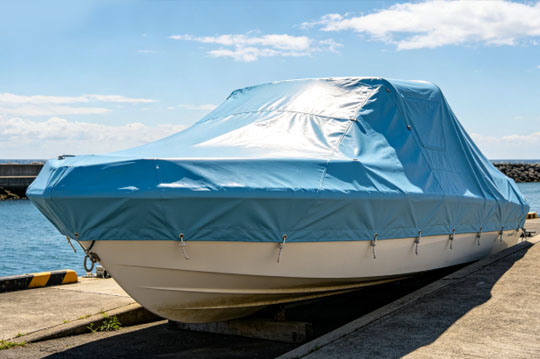
Long-Term Exposure Can Cause Multiple Effects
After a speedboat is moored, the hull continues to be affected by environmental conditions even when the boat is not in use. Rainwater can fall onto the deck and seating areas, sunlight continuously exposes exterior surfaces, and humidity in coastal air can also increase the cleaning and maintenance requirements for the hull surface and equipment areas. If ordinary covering materials do not provide sufficient waterproof performance, they may absorb water or develop leaks after continuous rainfall. If the material is exposed to ultraviolet radiation for a long time, it may gradually become harder and age. Therefore, covering materials for parked speedboats need to consider waterproofing, sun resistance, abrasion resistance, and fastening stability at the same time.
Speedboats usually have structures with a lower bow and higher stern, protruding cockpits, windshields, steering areas, and cabins at different heights. If the tarpaulin is too small, exposed areas may remain after covering. If it is too large, it may swing significantly under wind pressure. Tarpaulin covers need to be cut according to the hull dimensions. Reasonable allowances should be reserved around the bow, stern, and both sides, while the locations of fastening points should also be considered.
Short-term mooring mainly requires quick covering and rain protection, while long-term mooring places greater emphasis on material weather resistance, edge strength, and fastening stability.
Mooring Situation Main Requirements PVC Tarpaulin Configuration Focus | ||
Daily short-term mooring | Rainproof, dustproof | Waterproof PVC fabric, easy installation and removal |
Mooring for several consecutive days | Rainproof, sun protection | Waterproof, UV-resistant, reinforced edges |
Long-term mooring | Comprehensive protection | Heavy Duty PVC Tarpaulin, reinforced edges, properly positioned grommets |
Long-term outdoor mooring | Windproof, rainproof, sun protection | Thicker material, secure fastening, suitable cover dimensions |
Although the material itself provides good protective performance, improper fastening may still cause lifting, friction, and water accumulation under wind pressure.
Before making a speedboat tarpaulin cover, the total hull length, maximum width, and height areas requiring coverage need to be measured. If full coverage is required, the positions of the windshield, seats, control console, and other protruding parts should also be recorded. It is recommended to make the cover according to actual measurements rather than selecting it entirely based on the nominal hull dimensions. Appropriate allowances at the tarpaulin edges can facilitate the installation of grommets, ropes, or other fastening devices and can also provide more complete coverage.
PVC Tarpaulin is usually made from a fabric base with a PVC coating. Different tarpaulin products can be produced through different thicknesses, weights, and processing methods.
When used for parked speedboats, the key performance indicators to consider include:
Waterproof Performance: Reduces rainwater from entering the cabin, seating, and deck areas.
Weather Resistance: Maintains good performance when exposed to sunlight and outdoor environmental conditions for extended periods.
Tensile Strength: The cover needs to be repeatedly pulled during installation and removal, so the edges and fastening areas need to have sufficient strength.
Abrasion Resistance: Areas where the tarpaulin contacts the hull may experience friction, so the material needs to provide good abrasion resistance.
Easy Cleaning: Dirt and stains that form on the surface should be relatively easy to clean during routine maintenance.
PVC tarpaulin should not be made from material that is too heavy, as excessive weight can increase the difficulty of installation and removal. If the material is too thin, it may not meet the requirements for long-term outdoor covering. A common selection method is to adjust the material according to the speedboat dimensions, mooring duration, and local weather conditions. For larger speedboats, the material weight can be controlled while meeting protection requirements, making daily covering more convenient.
During the installation of speedboat tarpaulin covers, stress is mainly concentrated along the edges and fastening points. If the edges are not reinforced, deformation or wear may occur after long-term tensioning. Therefore, speedboat Tarp Covers can use reinforced edge designs, adding strength to the edges to make the fastening areas more stable. For large-area tarpaulins, corresponding load-bearing points can also be added according to the actual dimensions.
Grommets are important points for securing tarpaulin covers. If the distance between grommets is too large, local areas of the tarpaulin may become loose. If the distance is too small, the number of processing points will increase and may also affect the overall structure. A reasonable Tarp with Grommets design should be arranged according to the speedboat outline and fastening points. Additional fastening points can be added at the bow, stern, and areas on both sides that are more exposed to wind according to actual requirements.
The following table can be used as a basic reference for customization:
Customization Item Details to Confirm Main Purpose | ||
Tarpaulin Dimensions | Length, width, coverage height | Ensure complete coverage |
Material | PVC material, thickness, weight | Match durability requirements |
Edges | Edge binding, reinforcement treatment | Improve edge stability |
Grommets | Quantity, spacing, positions | Facilitate fastening |
Color | Specified color or standard color | Meet appearance requirements |
Processing Form | One-piece, seamed, or custom-cut | Match the speedboat structure |
After the tarpaulin is installed, it should remain relatively flat. If some areas are too loose, rainwater may collect in low areas and cause water accumulation. If the tarpaulin is pulled too tightly, excessive stress may be placed on the grommets and edges. Therefore, the tension should be adjusted according to the hull shape during installation so that rainwater can drain naturally while avoiding obvious long-term friction between the tarpaulin and certain parts of the hull.
Before using a Tarp Cover, sharp debris, sand particles, and obvious stains on the hull surface should be removed. After the tarpaulin is installed, long-term friction can cause even small particles to contribute to wear. If there is standing water on the hull surface, it should be removed before installing the tarpaulin. Keeping the contact areas relatively clean helps reduce stains caused by long-term covering.
After unfolding the tarpaulin, determine the front and rear directions first, then gradually adjust the positions on both sides. During fastening, do not tighten only one position. Instead, gradually adjust multiple fastening points to distribute the overall load more evenly. For large Boat Covers, installation by two people is recommended. This can reduce friction between the tarpaulin and the hull during handling and also make it easier to adjust the covering position.
During long-term mooring, the grommets, edge bindings, and areas where the tarpaulin contacts the hull should be inspected regularly. If loose fastening points, local tarpaulin wear, or water accumulation are found, adjustments should be made promptly. During the rainy season or in strong wind conditions, it is especially important to check whether the tarpaulin remains stable. The purpose of waterproof tarpaulin is not only to block rain; stable coverage also determines the actual protection performance.
After a speedboat tarpaulin has been used for a period of time, dust, water stains, and other contaminants may accumulate on the surface. After cleaning, it should be fully dried before folding and storing. Storing the tarpaulin while it remains damp for a long time may cause odors and is not beneficial for maintaining good service performance. During storage, avoid placing it together with sharp objects and reduce unnecessary folding friction.
Yes. Different speedboat models have different hull dimensions and structures. PVC Tarpaulin can be cut and processed according to length, width, coverage area, and fastening positions. Grommets and reinforced edges can also be configured as required.
There is no fixed size. It needs to be determined according to the actual structure of the speedboat. During measurement, not only the hull length and width should be recorded, but also protruding structures such as the windshield, seats, and control area should be considered, along with the space required for edge fastening.
The weather resistance of different PVC tarpaulins varies. For long-term outdoor use, PVC materials suitable for outdoor environments should be selected, with requirements such as UV resistance considered. Proper installation and regular inspection can also help extend service life.
Speedboat tarpaulin is usually secured along the edges, where wind and tension are concentrated around the grommets. Reinforced edges can improve the load-bearing capacity of these areas and reduce the risk of tearing or deformation during long-term use.
During speedboat mooring, PVC waterproof tarpaulin can provide continuous external covering for the hull, seats, deck, and related equipment, reducing the effects of rainwater, ultraviolet radiation, dust, and humid environments. When selecting a suitable Boat Cover, the speedboat length, width, structural height, mooring duration, and local climate conditions should be considered comprehensively. At the same time, attention should be paid to the thickness, weight, waterproof performance, weather resistance, tensile strength, and edge processing quality of the PVC Tarpaulin. Proper dimensional design, reinforced edge treatment, and grommet layout can help improve the stability of the tarpaulin after installation and reduce loosening, friction, and water accumulation caused by wind. NEWSTAR PLASTIC INDUSTRY CO., LTD. specializes in the design, production, and supply of PVC Fabric, PVC Tarpaulin, PVC Canvas, and other PVC industrial fabrics, with more than 30 years of industry experience. The company is equipped with a professional technical team. Its products comply with relevant European and American standards and have passed SGS certification, with exports to more than 40 countries and regions. For speedboat mooring cover requirements, customized recommendations can be provided according to hull dimensions, application environment, material specifications, colors, grommet quantity, and edge reinforcement methods, helping purchasers establish a more stable and durable protection solution.
For the purchase of PVC waterproof tarpaulin for speedboats, Boat Covers, or Heavy Duty Tarp, please contact NEWSTAR PLASTIC INDUSTRY CO., LTD. to further confirm product specifications, processing requirements, samples, and bulk supply solutions.
Email: tarp@newstarventilation.com
Phone: 0086-13921439224
