
Hot Keywords:
- All
- Product Name
- Product Keyword
- Product Model
- Product Summary
- Product Description
- Multi Field Search

During outdoor storage of powdered materials, the most critical issues to address are the impacts of external factors such as rainwater, moisture, wind, sand, and dust. Fertilizers, feed raw materials, mineral powders, and certain industrial powders can easily develop problems such as dampness, caking, and material loss if they are not properly covered. This may also increase on-site cleaning workload and material management pressure. Therefore, when storing powdered materials outdoors, a complete rainproof covering solution should be developed from aspects such as tarpaulin material selection, stacking methods, drainage structure, edge fixation, and daily maintenance, ensuring protection requirements while maintaining operational efficiency.
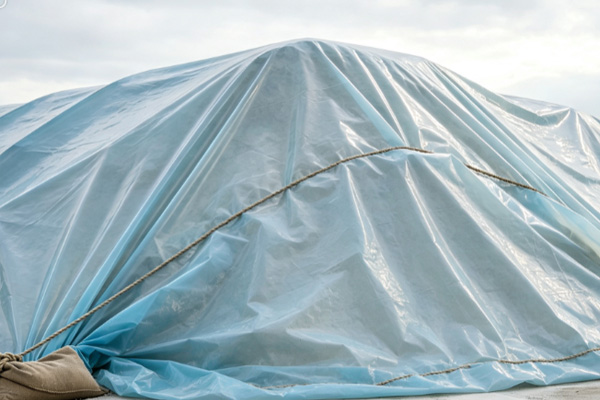
Compared with block or granular materials, powdered materials are more sensitive to moisture and environmental changes. Whether the covering method is appropriate directly affects material condition and subsequent usability.
Outdoor storage yards are first exposed to rainfall, especially during continuous rain or short-term heavy downpours, when ordinary covering methods may fail to provide stable protection.
Waterproof PVC tarpaulins can form a protective layer between materials and rainwater.
Properly designed tarpaulin slopes help reduce water accumulation on top.
Reducing damage and seam locations can lower the risk of water leakage.
Effective basic waterproofing is the most important protection measure for outdoor storage of powdered materials.
Once powdered materials absorb moisture, their physical state and performance are directly affected, mainly in the following ways:
Caking after moisture absorption, reducing usability.
Decreased flowability, increasing conveying and handling difficulty.
Decline in material quality, leading to additional processing costs.
Fertilizers and powder raw materials are more susceptible to humidity in long-term outdoor environments.
A complete tarpaulin covering system can effectively reduce direct contact with rainwater and moisture, minimizing the risk of dampness at the source.
Powdered materials easily generate dust in dry and windy conditions, affecting the environment and site management. Proper covering reduces exposed surface area and, combined with standardized stacking and management practices, helps control dust dispersion. For sites with strict environmental requirements, covering is an essential management measure.
Different-scale storage yards require different covering methods. Design should consider stacking height, area, climate conditions, and loading/unloading frequency.
Powdered materials are usually stored in piles, and their shape directly affects drainage performance and covering method.
High piles can use arched or sloped covering to allow natural water runoff.
Large flat storage areas are suitable for full coverage with reinforced edges.
Multiple independent piles can use zoned covering for easier management and handling.
Proper matching of pile structure helps reduce water accumulation and improve tarpaulin utilization efficiency.
The larger the coverage area, the more critical size planning becomes. Too small will leave exposed areas, while too large increases construction difficulty.
Storage Scenario | Main Issues | Covering Solution | Key Focus |
Small powder pile | Coverage efficiency | Single-piece full coverage | Size matching |
Medium storage yard | Rain and dust | Zoned or full coverage | Edge fixation |
Large storage yard | Large area, wind impact | Modular coverage | Strength and connection |
Long-term outdoor storage | Sun and rain exposure | Heavy-duty PVC tarpaulin | Weather resistance, UV resistance |
Rainy and windy regions | Wind and rain impact | Reinforced coverage | Waterproofing, tear resistance |
Proper sizing helps balance protection performance and construction efficiency.
In large-area covering, seam design directly affects waterproof reliability:
Excessive seams increase leakage risk.
Wide-width tarpaulins should be preferred to reduce joints.
Laying direction should be planned to avoid high-stress and water-accumulation areas.
When seams are necessary, sealing and reinforcement should be strengthened.
Optimized seam structure significantly improves overall protection performance.
This further enhances overall rainproof stability and service life.
Material selection is a core step and should be based on actual environmental conditions rather than price or thickness alone.
Waterproofing is a fundamental requirement. PVC-coated tarpaulins achieve waterproofing through a fabric base and coating structure, while seam quality must also be considered. Only when both material and workmanship meet requirements can a reliable protection system be formed.
Storage yard environments are complex, and tarpaulins are subject to friction and pulling during use:
High-frequency use requires strong tear resistance.
Large-area coverage requires overall structural strength.
Ground-contact areas should minimize wear.
High-strength materials are more suitable for repeated use scenarios.
UV Resistance and Weather Resistance
Long-term outdoor storage places higher demands on material performance:
UV resistance slows down ultraviolet aging.
Anti-aging properties maintain strength and flexibility.
Weather resistance adapts to sun, wind, and rain exposure.
Long-term use should consider full life-cycle cost.
By selecting materials with appropriate performance and combining them with scientific covering and maintenance methods, the stability and safety of outdoor storage of powdered materials can be significantly improved.
The fixing system directly affects overall stability and is a key component of rainproof covering.
Edges are the most wind-sensitive areas and should be prioritized:
Use weights, binding, or anchoring structures.
Reinforce corners and edge fixing points.
Avoid concentrating stress on a few points.
Once edges are stabilized, the overall structure becomes more reliable.
Water accumulation on top increases load and affects service life:
Set slopes according to pile shape.
Guide rainwater for natural drainage.
Install drainage paths when necessary.
Timely drainage reduces structural stress.
Outdoor environments require continuous maintenance:
Check whether fixing points are loose.
Check for tarpaulin damage.
Check for seam cracking.
Check for water accumulation.
Timely handling of minor issues can prevent larger losses.
Protection of powdered materials in outdoor storage is not simply about covering. It requires overall planning based on material hygroscopic properties, stacking form, and site conditions. From tarpaulin selection and structural setup to edge reinforcement and daily maintenance, every detail directly affects the stability of protection performance. Newstar Plastic Industry Co.,Ltd. specializes in the R&D and production of PVC tarpaulins and PVC-coated materials. According to different requirements of fertilizers, feed, and industrial powders, the company provides customized products with various specifications, weights, and functional configurations, helping customers build stable and durable rainproof covering solutions for outdoor storage.
