
Hot Keywords:
- All
- Product Name
- Product Keyword
- Product Model
- Product Summary
- Product Description
- Multi Field Search

Temporary cargo storage is commonly used for peak-season inventory preparation, warehouse expansion, engineering material turnover, and logistics transfer. Compared with permanent warehouses, PVC tents can be erected quickly and offer flexible space adjustment. However, when exposed to outdoor conditions for extended periods, rainwater, standing water, moisture, and strong winds may all affect cargo safety. To achieve rainproof storage, it is not enough to focus only on the waterproof performance of the tent fabric. The tent structure, drainage design, ground conditions, cargo placement, and daily maintenance must also be considered comprehensively to balance protection and operational efficiency.
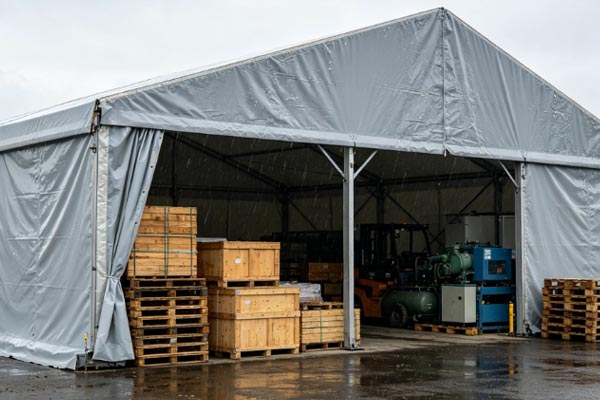
Temporary storage is often located outdoors or in semi-open areas, making cargo vulnerable to weather conditions. Taking rainproof measures in advance can reduce losses and improve storage efficiency.
Cartons, wooden crates, packaging materials, and some finished products may soften, deform, develop mold, or experience label detachment after exposure to water. For metal products, mechanical components, and engineering materials, rainwater may also cause rust. PVC tents can form a continuous sheltered space through roof fabric and sidewalls, reducing direct contact between rainwater and cargo. For moisture-sensitive goods, pallets, racks, and moisture-proof mats should also be used to prevent direct contact with the ground.
PVC tents are easy to erect and dismantle, and their space can be adjusted according to site conditions. They can be used for temporary storage, sorting, and loading and unloading.
Suitable for temporarily increasing storage capacity;
Space can be adjusted according to cargo volume;
Easy to connect with existing warehouses or logistics routes;
Reduces the time and investment required for permanent building expansion.
Flexible space configuration is an important value of temporary PVC tent storage.
In addition to rain protection, outdoor storage also requires reasonable design to reduce the impact of moisture, dust, and temperature changes on cargo:
Sidewalls can reduce the entry of external dust, rainwater, and debris;
Door curtains can reduce the likelihood of rainwater and dust entering when personnel and vehicles pass through;
Select an appropriate level of enclosure according to the type of cargo;
Reserve suitable ventilation positions for products that require airflow;
Avoid keeping the tent completely sealed for long periods to reduce moisture accumulation;
Classify and manage cargo according to its moisture resistance, ventilation requirements, and storage conditions.
Rain protection, moisture control, and ventilation need to be balanced according to cargo characteristics in order to create a suitable protective environment for outdoor storage.
Different cargo types vary in specifications, weight, and storage duration. PVC tents should therefore be designed according to actual conditions rather than using a one-size-fits-all solution.
Cargo type and usage period are important factors in selecting the tent structure and fabric specifications.
Storage Scenario | Common Cargo | Main Risks | Recommended Rainproof Method | Key Performance |
Short-term inventory preparation | Cartons, daily necessities, finished products | Rainwater, dust | Quickly erected enclosed tent | Waterproof, dustproof |
Engineering material storage | Building materials, steel, mechanical components | Moisture, rust, impact | Reinforced sidewalls with designated zones | Abrasion-resistant, tear-resistant |
Logistics transfer | Turnover boxes, palletized cargo | Frequent entry and exit, wind-driven rain | Enlarged entrance with door curtains | Rainproof, easy loading and unloading |
Long-term temporary storage | Equipment, inventory products | UV exposure, aging, standing water | Reinforced anchoring and drainage | Weather-resistant, UV-resistant |
Moisture-sensitive cargo storage | Paper products, electronic products, precision components | Humidity, condensation | Enclosed structure with bottom isolation | Moisture-resistant, sealed |
Matching the rainproof configuration to the cargo and storage period helps avoid insufficient protection or excessive investment.
If rainwater falling on the tent roof cannot be discharged promptly, it may accumulate and increase the pressure on the fabric and frame. The following points should be considered during design:
Maintain a continuous roof slope and avoid low-lying areas;
Direct rainwater away from entrances and cargo storage areas;
Reserve drainage space on both sides of the tent;
For large tents, consider drainage channels or water-diversion facilities;
Confirm before installation that the site will not experience obvious water accumulation.
Reducing standing water helps lower the risks of leakage, deformation, and structural stress.
Large PVC tents usually require multiple fabric panels to be joined. Seams, edges, and entrances are vulnerable areas where water may enter. To improve rainproof performance, pay attention to the following:
Seams: Use heat welding or similar methods to reduce water penetration.
Edges: Thicken and reinforce them to improve tensile and tear resistance.
Entrances: Select suitable door curtains or rain shields according to forklift traffic frequency.
Inspection: Regularly inspect seams, edges, and door curtains, and promptly repair any damage or looseness.
Addressing these details can improve the overall rainproof performance of the PVC tent.
Rainproof performance depends not only on the tent’s appearance. PVC fabric performance, cargo placement, and aisle design also affect storage safety and efficiency.
PVC-coated fabric offers waterproof, abrasion-resistant, and tear-resistant properties, making it suitable for temporary storage tents, logistics covers, and outdoor protection. When purchasing, it is recommended to consider the following:
Stable waterproof performance;
Fabric base strength that meets usage requirements;
UV resistance and weather resistance;
Low risk of water penetration after seam processing;
Suitability for repeated assembly and dismantling;
Matching weight and flexibility for the tent span.
Only when material specifications match the operating environment can protection and overall cost be balanced.
Cargo should be placed on pallets, racks, or boards and kept away from the tent edges. Moisture-sensitive cargo should not be placed near sidewalls or directly on the ground.
Pallets can reduce contact between cargo and the ground;
Racks help with classification and ventilation;
Leaving space along the edges facilitates inspection and drainage;
Keeping gaps between cargo units makes handling and inspection easier.
Only when bottom isolation is properly implemented can the tent’s rainproof system be considered complete.
Temporary storage tents need to support handling and cargo turnover. The internal space can be planned as follows:
Reserve main aisles for personnel and forklift traffic;
Store cargo in zones according to type and size;
Set up an independent loading and unloading area to reduce interference;
Reserve an inspection area for temporarily storing incoming, returned, or abnormal cargo;
Determine aisle width according to forklift operations;
Determine stacking height according to tent height;
Provide larger entrances where traffic is frequent;
Add rain shields at entrances.
Reasonable zoning and optimized aisles allow temporary storage tents to combine rain protection, storage, and cargo turnover.
Even when materials and design are appropriate, improper installation and anchoring may still result in loose fabric, standing water, or leakage during strong winds and heavy rain. Post-installation inspection and maintenance are therefore equally important.
The anchoring method should be selected according to whether the site has a concrete surface, asphalt surface, soil ground, or gravel area. During installation, focus on checking the following:
The four corners are securely anchored;
Load-bearing points along the edges are evenly distributed;
Connectors are fully tightened;
The frame has no obvious shaking;
Fabric tension is appropriate to avoid excessive local stress.
In areas with strong winds, additional ropes, ground anchors, or other auxiliary anchoring measures should be added to prevent the fabric from being lifted.
Before the rainy season, inspect the fabric, seams, door curtains, drainage areas, and anchoring components in advance. After heavy rain or strong winds, promptly check for standing water on the roof, loose edges, and ground water backflow. If wear, loose fasteners, or localized leakage is found, it should be addressed as soon as possible to prevent the problem from expanding.
After the rainproof tent is put into use, it should also be supported by proper storage management measures. For moisture-sensitive cargo, dehumidifiers, desiccants, or temperature and humidity monitoring tools can be used. For metal cargo, surface rust should be checked regularly. Cartons and packaging materials should not be placed close to sidewalls for long periods or stacked in poorly ventilated areas. Only through the coordinated use of material protection, structural rainproofing, and storage management can cargo safety be continuously improved.
The core of a rainproof PVC tent solution for temporary cargo storage is not simply selecting waterproof fabric, but establishing a complete protection system based on cargo type, storage duration, site conditions, and logistics processes. Newstar Plastic Industry Co.,Ltd. specializes in PVC tarpaulins, PVC-coated fabrics, and outdoor protective materials. Based on requirements such as temporary storage, engineering material storage, logistics transfer, and warehouse expansion, the company provides customized support in different specifications, weights, weather-resistance levels, and processing methods, helping customers create PVC tent storage solutions that offer reliable rain protection, flexible installation, and suitability for long-term use.
