
Hot Keywords:
- All
- Product Name
- Product Keyword
- Product Model
- Product Summary
- Product Description
- Multi Field Search
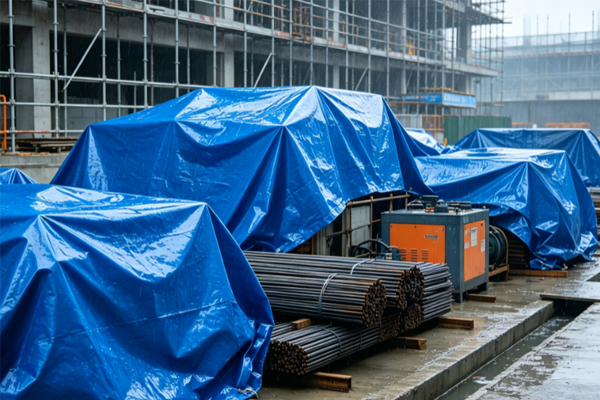
A heavy rainstorm may only be a minor inconvenience for most people, but on a construction site, it can quickly turn into a real problem. Steel bars, timber, cement, pipes, machinery, and temporary work areas can all be affected by rain. When a project is working against a tight schedule, there is little time to move everything indoors or clean up water damage after every storm. For construction projects, especially large sites with extensive outdoor storage areas, preparing reliable rain protection in advance can make daily work much easier. PVC and Canvas tarpaulins can be selected for different construction areas, providing practical protection without relying on last-minute material relocation.
Construction sites usually have large quantities of materials stored in different areas. Some materials may be used immediately, while others may remain outdoors for days or even weeks before they are needed. During continuous rainfall, exposed materials can become difficult to manage and may require additional cleaning or handling. Identifying materials that are particularly vulnerable to moisture is a good starting point for rainy-season protection.
Steel bars, steel pipes, and metal profiles are often stored outdoors in large quantities. A short period of rain may not immediately cause serious problems, but prolonged exposure to moisture can lead to surface rust. On a large construction project, moving tons of materials indoors every time it rains is simply unrealistic.
Cover steel storage areas with suitable tarpaulins;
Raise materials above ground level where possible;
Leave appropriate drainage space around the edges;
Add sufficient fixing points for large covering areas.
The benefit is straightforward: materials do not need to be moved every time rain arrives, and workers can still access them easily when needed.
Timber formwork and wooden beams are widely used in construction, and many projects deliver these materials to the site before they are needed. Long-term exposure to rain can cause moisture absorption, deformation, or mold, which may require additional sorting before use.
When covering timber, do not focus only on the top. The sides and bottom matter too. Combining tarpaulin covering with raised storage, proper drainage, and secure fixing can provide more complete protection.
Cement, putty powder, dry mortar, and similar materials are sensitive to moisture. Once packaging is damaged or water reaches the storage area, these materials can easily form lumps and become difficult or impossible to use. For materials that cannot immediately be moved into a warehouse, a dedicated rainproof covering area can help reduce losses caused by sudden rainfall.
Construction tarpaulins are different from ordinary rain covers. On a construction site, tarpaulins are frequently pulled, folded, moved, and reinstalled. They also need to deal with rain, sunlight, and wind. Buying purely based on price can create problems later if the material is difficult to install, unsuitable for the area, or does not last long enough.
Before purchasing, consider how long the tarpaulin will be used, what it will cover, and how often the area changes.
PVC tarpaulins are well suited to construction areas that require long-term outdoor protection. They offer good waterproof performance and can be used for material storage areas, machinery parking zones, and temporary storage structures.
Suitable for covering steel bars and steel pipes;
Can protect machinery and construction tools from rain;
Suitable for extended outdoor protection;
Relatively easy to clean.
For a material storage area that needs to remain protected throughout the rainy season and later stages of construction, PVC tarpaulins can be a practical choice.
Construction sites often change as work progresses. A material storage area may become an equipment zone a few days later, while another work area may need temporary rain protection. In these situations, tarpaulins need to be easy to move and reinstall.
Canvas tarpaulins can be used for temporary material covering, work areas, and short-term equipment protection. They can be moved when necessary without adding too much complexity to the site layout.
There is no need to use the same tarpaulin throughout the entire construction site. Long-term outdoor areas can prioritize durability and waterproofing, while frequently changing areas may need greater flexibility and ease of handling.
Application | Main Problem | Recommended Material | Key Consideration |
Steel bars and pipes | Rain, moisture, rust | PVC tarpaulin | Cover the top and secure the edges |
Timber formwork and beams | Moisture, deformation | PVC / Canvas | Create a drainage slope |
Cement and mortar | Water exposure, damaged packaging | PVC tarpaulin | Focus on sealing and ground insulation |
Construction machinery | Rain, sunlight, dust | PVC tarpaulin | Select a suitable size and reinforce fixing |
Temporary material area | Changing weather, frequent movement | Canvas tarpaulin | Easy installation and reuse |
Temporary construction shelter | Rain and sun protection | PVC / Canvas | Match the cover to the structure |
Pipes and cables | Rainwater, mud, moisture | PVC tarpaulin | Raise materials above the ground |
Short-term work area | Temporary protection | Canvas tarpaulin | Prioritize mobility and ease of handling |
Separating different areas during planning makes it easier to control purchasing costs and ensures workers know which tarpaulin is intended for each application.
Many construction sites already have tarpaulins but still find materials damp after heavy rain. Sometimes the problem is not the tarpaulin itself but how it is installed. A cover placed directly on a pile of materials, standing water on the tarp, or poorly secured edges can all reduce protection performance.
When a tarpaulin is laid flat over a material pile, rainwater can collect in low areas. As the water accumulates, the weight increases and may eventually force water into the materials underneath.
Add simple supports above the materials where practical;
Create a slight slope when installing the tarpaulin;
Allow rainwater to flow naturally away;
Avoid obvious low points where water can collect.
It may seem like a small installation detail, but it can make a noticeable difference during prolonged rainfall.
Construction sites often have open areas where wind can become strong. If only the four corners are secured, wind can enter underneath the tarpaulin and lift the entire cover.
Fixing points should be distributed across the corners, edges, and, for large tarpaulins, suitable points in the central area. Secure installation keeps the cover stable and reduces the need for workers to repeatedly adjust it after bad weather.
Many people focus on whether the top is covered but forget about the ground. In some cases, moisture enters the material pile from standing water underneath rather than from the top.
Using pallets, wooden supports, or other suitable methods to raise materials above the ground creates space for water to drain away. Combining top rain protection with ground-level moisture control provides more reliable outdoor storage.
Even high-quality tarpaulins need proper management. Construction projects can last for months or years, and weather conditions can change quickly. Rain protection should be planned in advance instead of waiting until dark clouds arrive before looking for something to cover the materials.
Before continuous rainfall begins, inspect all existing tarpaulins. Previously used products should be checked carefully for damage, aging, or loose fixing points.
Inspect edges and fixing points;
Check the surface for tears or cracks;
Remove dirt and debris;
Prepare some spare tarpaulins.
A little preparation before the rainy season can save a lot of trouble when heavy rain arrives.
Randomly placing materials makes both site management and rain protection more difficult. Steel, timber, bagged materials, and equipment should ideally be stored in separate areas and kept away from low-lying locations where water can accumulate.
Once material storage areas are clearly defined, tarpaulin sizes, fixing methods, and drainage directions can be planned in advance. Workers can then follow the same process whenever rain is expected.
After heavy rain, do not immediately remove every tarpaulin. Check for standing water, shifted covers, loose fixing points, and moisture underneath the material.
If the tarpaulin will continue to be used, clean away mud and debris. If it will be stored, allow it to dry thoroughly before folding it away. Regular maintenance makes future reuse much easier.
Rainy-season construction protection is not simply about moving materials indoors whenever it rains. Planning the covering areas in advance, selecting the right material, and paying attention to fixing and drainage can significantly reduce weather-related problems. PVC tarpaulins are suitable for material storage areas, machinery protection, and long-term outdoor covering, while Canvas tarpaulins can be used for temporary construction areas and applications requiring frequent movement. NEWSTAR PLASTIC INDUSTRY CO., LTD. supplies PVC and Canvas tarpaulins for outdoor protection needs in construction, agriculture, aquaculture, and ventilation engineering.
