
Hot Keywords:
- All
- Product Name
- Product Keyword
- Product Model
- Product Summary
- Product Description
- Multi Field Search

When sea freight cargo is waiting for loading or transfer at ports, terminals, logistics yards, or warehouse transfer areas, temporary outdoor storage is often unavoidable. Rainwater, moisture, ultraviolet rays, sea wind, salt spray, and frequent loading and unloading may cause packaging to become damp, cargo surfaces to corrode, or the appearance of goods to be damaged. Using suitable PVC tarpaulin for covering, together with elevation, drainage, fastening, and regular inspections, can reduce the risk of cargo loss during the waiting period before transportation.
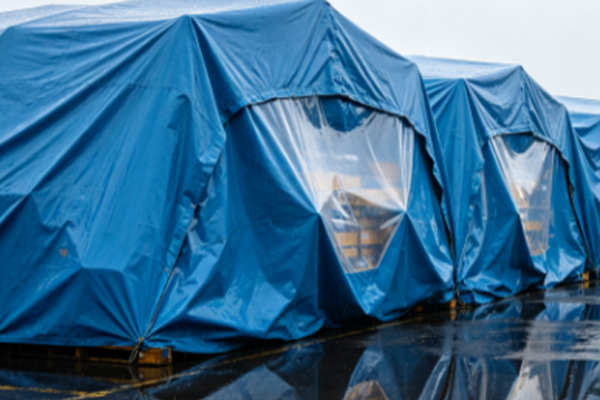
Short-term outdoor storage of sea freight cargo does not mean that simply covering it with a tarpaulin is sufficient. The type of cargo, packaging method, storage period, and local weather conditions all affect the protection plan.
When sea freight cargo is waiting for transfer, common risks mainly come from rainwater, moisture, sunlight, and loading and unloading operations.
Rainwater penetration: Continuous rainfall or accumulated water on the tarpaulin may cause cartons, wooden crates, and woven bags to become damp.
Ground moisture: When cargo is placed directly on the ground, the bottom is more likely to be affected by standing water and moisture.
Sun exposure: Long-term exposure to sunlight may cause packaging, plastic parts, and cargo surfaces to age.
Friction caused by strong winds: When the tarpaulin is not securely fastened, it may shift and rub against the cargo.
Loading and unloading damage: Forklifts, lifting equipment, and manual handling may cause dragging or scratching.
Temporary outdoor storage requires more than simply covering the cargo. It also requires protection against rain, moisture, sunlight, wind, and damage during loading and unloading.
PVC tarpaulin is made from high-strength polyester base fabric coated with PVC. Different weights, thicknesses, widths, and performance features such as waterproofing, UV resistance, abrasion resistance, and flame retardancy can be selected according to specific requirements. For outdoor storage of sea freight cargo, PVC tarpaulin is mainly used for:
Protection against rain;
Blocking sunlight;
Reducing exposure to windblown sand and dust;
Improving the tensile and tear resistance of the covering structure;
Producing large tarpaulins through heat-welding, thereby reducing the number of seams.
PVC tarpaulin is mainly used for external covering and cannot replace the cargo’s own moisture-proof, rust-proof, or dangerous goods protection measures.
Different types of cargo have different levels of sensitivity to rainwater, moisture, sunlight, and mechanical friction. The covering method should therefore be adjusted accordingly. Clarifying the characteristics of the cargo before purchasing can help avoid selecting tarpaulin based solely on price.
In actual projects, the main performance requirements of PVC tarpaulin can be determined according to the packaging method and cargo characteristics.
Type of Sea Freight Cargo | Main Outdoor Risks | Key PVC Tarpaulin Requirements | Supporting Protection Measures |
Carton-packaged cargo | Rainwater, moisture | Waterproof, moisture-resistant, tear-resistant | Elevate the cargo and improve drainage |
Wooden crate-packaged equipment | Rainwater, sun exposure, dust | Waterproof, weather-resistant, UV-resistant | Prevent the tarpaulin from directly rubbing against the packaging |
Palletized cargo | Rainwater, standing water, wind | Waterproof, tear-resistant, securely fastened | Elevate the pallets and fasten them around the perimeter |
Metal equipment | Rainwater, moisture, salt spray | Waterproof, weather-resistant | Combine with rust-proofing and corrosion protection |
Large machinery | Rainwater, dust, friction during loading and unloading | High strength, abrasion-resistant, tear-resistant | Customize the shape and reinforce load-bearing areas |
Plastic products or packaging materials | Sun exposure, rainwater, contamination | Waterproof, UV-resistant, easy to clean | Avoid standing water and prolonged exposure to sunlight |
Cargo requiring frequent loading and unloading | Opening and closing, dragging, friction | Flexible, abrasion-resistant, tear-resistant | Add openings and quick-fastening structures |
PVC tarpaulin can be configured with different functions according to the specific application, but the protection effect also depends on the covering method and on-site management.
Short-term transfer and long-term outdoor storage have different requirements for PVC tarpaulin. For short-term use, attention should be paid to whether the tarpaulin is easy to install and remove. For long-term use, greater importance should be placed on UV resistance, weather resistance, tear resistance, and abrasion resistance. During selection, the following factors should be confirmed:
Expected storage period;
Whether the cargo will experience a continuous rainy season;
Daily exposure time to sunlight;
Frequency of opening the tarpaulin and loading or unloading the cargo;
Number of folding and reinstallation cycles;
Whether vehicles or forklifts operate in the storage area.
The longer the storage period and the more frequently the tarpaulin is used, the more important its durability becomes.
Even when waterproof PVC tarpaulin is used, moisture, leakage, and covering displacement may still occur if water accumulates during installation, there are not enough fastening points, or the cargo is placed directly on the ground. On-site installation is just as important as material performance.
Outdoor storage should focus on drainage and moisture protection rather than relying solely on increasing tarpaulin thickness. The following measures are recommended:
Elevate the cargo using pallets or supports;
Maintain a certain slope on the tarpaulin to prevent water accumulation;
Direct rainwater toward drainage channels;
Avoid placing cargo in low-lying areas;
Inspect the edges of the tarpaulin to prevent rainwater from flowing back;
Check the tarpaulin after heavy rain for accumulated water or sagging;
Conduct regular inspections during long-term storage.
Protection should address rainwater from above, splashing from the sides, and moisture rising from below.
Ports, terminals, and temporary storage yards are often exposed to strong winds, and large tarpaulins are more likely to be blown or shifted. When covering large sea freight cargo, the four corners and side edges should be securely fastened, while the grommets and edges should be reinforced. Ropes or metal components should not scratch the PVC surface. When multiple tarpaulins are joined, sufficient overlap should be provided. After strong winds, check whether the fasteners, welded seams, and edges have become loose. High-strength base fabric can improve the tensile and tear resistance of the tarpaulin, but its actual wind resistance also depends on the tarpaulin size, fastening method, and on-site structure.
The cost of temporary outdoor storage includes not only tarpaulin procurement, but also installation labor, repeated loading and unloading, cargo damage, packaging replacement, and post-rain maintenance. A reasonable protection plan should reduce these hidden costs.
If the tarpaulin needs to be reused, durability is more important than price. During procurement, attention should be paid to:
Weight and thickness: Select according to the service period and covering method;
Base fabric strength: Affects tensile and tear resistance;
Abrasion resistance: Suitable for frequent loading, unloading, and folding;
UV resistance: Reduces aging caused by long-term sun exposure;
Waterproof performance: Meets outdoor covering requirements;
Welding performance: Suitable for producing large tarpaulins;
Edge reinforcement: Improves the durability of grommets and edges.
PVC tarpaulin can be supplied in specifications of approximately 200–1500 gsm, with different widths, thicknesses, UV resistance, flame retardancy, and antistatic properties available according to requirements. Selecting suitable materials can reduce replacement and maintenance costs.
Before purchasing in bulk, confirm the cargo dimensions, weight, packaging method, storage period, and local weather conditions. The required PVC tarpaulin weight, thickness, width, waterproof performance, UV resistance, abrasion resistance, and tear resistance should also be clearly defined. In addition, confirm whether flame retardancy, antistatic properties, edge reinforcement, grommets, ropes, openings, or curtains are required, as well as whether heat-welded finished products or rolls are needed. Sample testing should be conducted when necessary. PVC tarpaulin is mainly used for external covering of sea freight cargo. For cargo that is sensitive to moisture, corrosion, temperature, or chemical media, protection should also be combined with the original packaging, rust prevention, and moisture-proof measures.
The key to protecting sea freight cargo during temporary outdoor storage is not simply choosing a waterproof tarpaulin, but combining PVC material with cargo elevation, top drainage, wind-resistant fastening, loading and unloading procedures, and routine inspections. By properly planning the covering dimensions, fastening structure, and inspection frequency, the tarpaulin can remain stable in actual yard conditions. For cargo with different packaging characteristics and storage periods, appropriate opening, ventilation, and maintenance methods should also be arranged in advance.
