
Hot Keywords:
- All
- Product Name
- Product Keyword
- Product Model
- Product Summary
- Product Description
- Multi Field Search

During tunnel construction and operation, there are high requirements for the air circulation environment. Since tunnel spaces are relatively enclosed, natural air exchange capacity is limited. Dust generated by construction equipment, vehicle exhaust emissions, heat accumulation, and air changes caused by personnel activities may all affect the internal environment. Tunnel ventilation ducts play an important role in air transportation. Compared with ordinary ventilation pipes, tunnel-specific ventilation ducts need to withstand complex environments for long periods, including humid air, mechanical friction, frequent installation and dismantling, and significant changes in airflow pressure.
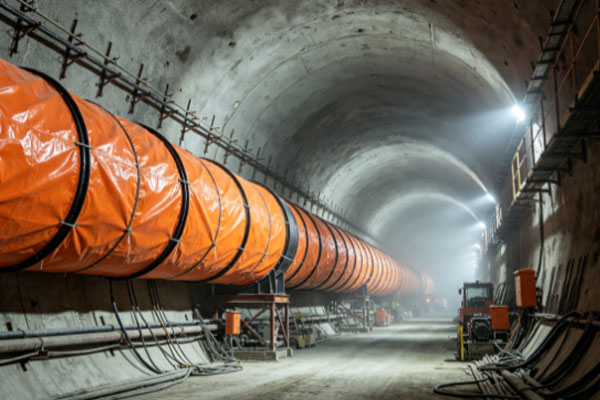
Therefore, ventilation duct materials not only need to provide good sealing performance but also require strong wear resistance, tear resistance, and weather resistance. Currently, tunnel ventilation ducts made of PVC coated fabric materials are widely used in tunnel construction ventilation systems due to their moderate weight, convenient installation, and stable waterproof performance. By selecting suitable material structures, processing technologies, and connection methods, these ducts can meet ventilation requirements for different tunnel lengths and construction stages, providing a continuous and stable air supply environment inside tunnels.
During tunnel construction, working areas are usually far away from tunnel entrances, making it difficult for air to circulate naturally and quickly. When mechanical equipment continues operating, air quality problems may easily occur inside the tunnel. Without reliable ventilation equipment and air delivery pipelines, fresh air cannot be delivered to the construction area in time, affecting the working environment of personnel. Therefore, tunnel ventilation ducts need to have continuous air delivery capabilities while maintaining low air resistance to reduce pressure loss during air transportation. A stable duct structure can help ventilation fans achieve better operating efficiency and distribute air more evenly to different areas inside the tunnel.
Tunnel lengths vary, resulting in significant differences in ventilation distances. Some projects require hundreds of meters or even longer ventilation duct installation. Therefore, materials need to withstand long-term suspension, stretching, and airflow impact. High-quality PVC ventilation duct fabric usually uses high-strength woven fabric as the base layer and enhances surface performance through PVC coating, making the overall structure more compact. Compared with ordinary flexible materials, this type of material is less likely to develop cracks or air leakage problems during long-term use.
The internal environment of tunnels is usually complex, with possible exposure to moisture, water vapor, mud, sand, and equipment collisions. If ventilation ducts lack sufficient durability, maintenance and replacement frequency will increase, affecting construction progress. Therefore, tunnel-specific ventilation ducts need to focus on material strength, waterproof performance, connection reliability, and daily maintenance convenience.
PVC Tarpaulin is a composite material formed by combining high-strength fiber fabric with PVC coating. This material has good waterproof, moisture-proof, and wear-resistant properties. The thickness, weight, and surface treatment methods can be adjusted according to different engineering requirements. When used in tunnel ventilation duct manufacturing, PVC materials can provide excellent air-tightness and reduce leakage during air transportation. At the same time, the flexible material structure makes transportation and on-site installation more convenient and allows adjustments according to changes in tunnel space.
Material Type | Main Characteristics | Suitable Applications | Performance |
PVC coated fabric | High strength, waterproof, wear-resistant | Long-term ventilation transportation environments | Stable overall performance |
PE material | Lightweight, lower cost | Short-term applications | Economical choice |
Canvas material | Good wear resistance | Environments requiring certain breathability | Higher maintenance requirements |
Ordinary plastic film | Low price | Temporary covering environments | Short service life |
Facing complex tunnel construction environments, PVC coated fabric is more suitable for ventilation ducts requiring long-term operation and repeated installation. Its excellent mechanical properties can reduce the probability of duct damage during construction.
In addition to material selection, manufacturing processes also directly affect the performance of tunnel ventilation ducts. Professional manufacturers usually customize production according to duct diameter, length, and connection methods. Common processing methods include heat welding, reinforced edge design, and installation interface treatment. Reasonable structural design can improve the overall pressure resistance of ducts while facilitating rapid installation on site and improving construction efficiency.
Different tunnel projects have different ventilation requirements. Therefore, duct design needs to consider tunnel length, number of workers, equipment quantity, and ventilation fan parameters. During the design stage, it is necessary to determine duct diameter, material thickness, connection methods, and installation methods. Proper matching can prevent oversized ducts from causing transportation and installation difficulties while avoiding insufficient sizes that affect ventilation performance.
Tunnel ventilation ducts usually need to balance strength and flexibility. Materials that are too thin may affect service life, while materials that are too thick may increase weight and installation difficulty.
Common choices include:
Standard PVC coated fabric: suitable for general tunnel ventilation requirements;
Thickened PVC fabric: suitable for long-distance and high-frequency usage environments;
High wear-resistant PVC material: suitable for areas with more complex construction environments.
Through different material combinations, different levels of engineering requirements can be met.
Tunnel construction periods are usually long, and ventilation systems may need continuous adjustment according to construction progress. Therefore, ventilation ducts must not only meet operational requirements but also be convenient for installation and removal. Reasonable interface design can reduce on-site installation time. Regular inspection of duct surface wear, connection points, and fixing devices helps extend the overall service life.
Different tunnel projects vary in length, construction stages, and ventilation requirements. Therefore, ventilation ducts cannot use a single standard specification. Professional manufacturers design duct diameter, length, material thickness, connection methods, and other parameters according to engineering data provided by customers, making the products better suited to actual working environments. During actual construction, ventilation ducts need to extend continuously as excavation progresses. Therefore, products must not only be easy to transport but also feature rapid installation characteristics. Ventilation ducts made from flexible PVC coated materials can be adjusted according to changes at the construction site while reducing complicated installation procedures. Through customized solutions, the matching between ventilation ducts and ventilation equipment can be improved effectively, ensuring more stable air transportation and reducing maintenance costs caused by duct-related problems during construction.
Tunnel ventilation ducts operate continuously for long periods, and material performance directly affects the overall service life. High-quality PVC coated fabric usually uses high-density fibers as the basic structure and combines them with PVC surface treatment, allowing the material to achieve both flexibility and tensile strength. Compared with ordinary materials, PVC ventilation duct fabric is less likely to experience significant deformation when subjected to stretching, folding, and airflow pressure changes. At the same time, waterproof surface treatment can reduce the impact of humid environments on material performance. For tunnel projects requiring long construction periods, selecting PVC materials with better wear resistance and weather resistance can reduce duct replacement frequency and improve the stability of the ventilation system.
Tunnel construction environments usually have limited space, so equipment transportation and installation need to consider convenience. Therefore, ventilation duct design should not only focus on material performance but also optimize the overall structure.
Common designs include:
l Reinforcing duct edges to improve the strength of connection points;
l Optimizing interface structures to facilitate connection between multiple duct sections;
l Adding fixing support designs to improve installation stability;
l Adjusting duct dimensions according to fan parameters to reduce operating resistance.
Reasonable structural design allows construction workers to complete installation more quickly while making later inspection and maintenance more convenient.
Tunnel ventilation ducts have high requirements for material stability. Choosing an experienced material supplier can provide a more reliable foundation for duct manufacturing. Newstar PVC Tarpaulin is manufactured using high-quality PVC coated fabric, featuring excellent waterproof performance, wear resistance, and tensile strength. Different specifications and thickness options can be provided according to customer requirements.
During PVC material production, raw material selection, coating processes, and finished product inspection all affect final performance. Newstar controls the thickness, strength, waterproof performance, and surface quality of PVC fabrics through a complete production process, providing customers with stable and reliable material support.
Different projects have different requirements for ventilation duct materials. Some projects focus more on lightweight installation, while others emphasize long-term wear resistance. Newstar can provide suitable PVC material solutions according to customer requirements, including different weights, colors, thicknesses, and surface treatment methods, helping customers select more suitable materials for ventilation duct manufacturing. If you are looking for a stable PVC material supply solution for tunnel ventilation duct production, please contact the Newstar professional team. We will provide PVC tarpaulin material recommendations and customized services according to project requirements.
PVC materials have good waterproof, wear-resistant, and tensile properties, allowing them to adapt to humid, dusty, and long-term operating environments inside tunnels. At the same time, PVC coated fabric has moderate weight and is convenient for transportation and installation, making it a commonly used material in tunnel ventilation duct manufacturing.
The service life of ventilation ducts is related to material quality, construction environment, and maintenance conditions. Ducts made of high-strength PVC materials can maintain a long service life under normal use and regular inspection. The actual replacement time should be determined according to surface wear, connection conditions, and overall sealing performance.
Yes. Professional manufacturers can customize duct diameter, length, and connection methods according to tunnel length, ventilation fan parameters, and installation conditions, making products more suitable for engineering requirements.
Quality can be evaluated based on several basic factors, such as whether material thickness is consistent, whether the surface is smooth, whether connection points are firm, and whether tensile strength meets requirements. In addition, choosing manufacturers with production experience and quality certifications can also reduce risks during later use.
Compared with traditional rigid pipes, PVC flexible ventilation ducts are more flexible. They can be folded for storage during transportation and adjusted according to site conditions during installation. Proper interface design and fixing methods can further improve construction efficiency.
Tunnel ventilation systems are an important part of maintaining a safe construction environment, and ventilation ducts, as key components for air transportation, directly affect the operating performance of the entire system through their material quality and structural design. Facing conditions such as humidity, dust, equipment operation, and long-distance air transportation inside tunnels, selecting suitable duct materials is essential. PVC coated fabric, with its waterproof performance, wear resistance, stable strength, and convenient installation characteristics, can effectively meet the requirements of tunnel ventilation duct applications. By selecting appropriate material specifications, optimizing manufacturing processes, and designing according to actual engineering conditions, ventilation systems can maintain more stable operating performance.
If you are looking for PVC materials suitable for tunnel ventilation duct manufacturing, please contact Newstar. We will provide professional recommendations and reliable product support to help improve ventilation duct quality and engineering application performance.
Email: tarp@newstarventilation.com
Phone: 0086-13921439224
