
Hot Keywords:
- All
- Product Name
- Product Keyword
- Product Model
- Product Summary
- Product Description
- Multi Field Search

An underground powerhouse of a hydropower station is usually located inside a mountain or underground cavern. The space is relatively enclosed, equipment is concentrated, and personnel need to carry out long-term inspections, operation and maintenance, and repair work. Compared with above-ground powerhouses, underground environments have weaker air circulation. Heat, moisture, and air pollutants generated during equipment operation are more likely to accumulate in local areas. Therefore, reasonable ventilation design is important for maintaining air circulation inside the powerhouse, improving the working environment, and ensuring normal equipment operation.
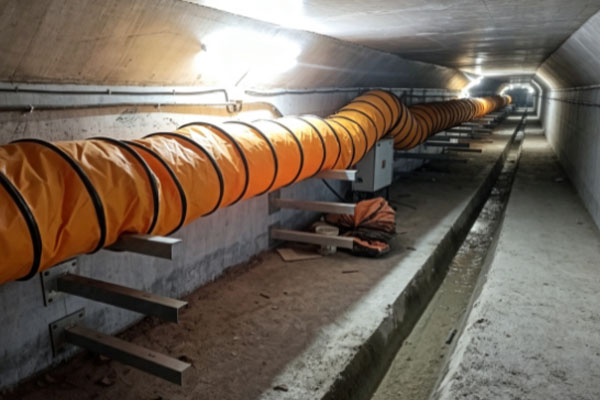
During the construction of an underground hydropower station, ventilation is not simply a matter of installing fans and ventilation ducts. It requires overall planning based on the layout of the underground powerhouse, the number of generating units, equipment heat generation, personnel activity areas, and air intake and exhaust conditions. In particular, when there are elevation differences and complex connections between the main powerhouse, installation bay, busbar tunnel, access tunnel, and equipment levels, the intake, air supply, and exhaust routes need to be arranged properly. For some underground powerhouses with long distances and large spaces, the durability, airtightness, and on-site installation conditions of the ventilation ducts also need to be considered.
The air environment inside an underground powerhouse is significantly different from that of above-ground buildings with relatively good natural ventilation conditions. The mountain itself obstructs natural air exchange, while the powerhouse contains a large number of concrete structures, metal equipment, and electromechanical facilities. Hydropower generating units, transformers, and other equipment continuously generate heat during operation. If the air cannot circulate in time, heat may accumulate around equipment or in local spaces. At the same time, underground environments are generally more humid, and some areas may also be affected by water seepage, condensation, and water vapor. Long-term exposure to a hot and humid environment not only affects personnel comfort but may also have adverse effects on certain equipment, wiring, and metal components. Therefore, ventilation needs to take into account air exchange, heat removal, and moisture control.
Hydropower generating units generate a certain amount of heat during operation. This is especially noticeable in areas where units operate continuously and equipment is concentrated, where local temperatures may be significantly higher than in other areas. Proper air supply and exhaust can help maintain continuous air movement, remove hot air around the equipment, and keep the internal temperature of the powerhouse within a relatively stable range. For equipment levels, generator levels, and other spaces, air supply locations should be determined according to equipment layout to avoid concentrating air supply in one area while leaving other areas with little or no air movement.
Underground powerhouses are prone to relatively high humidity. Especially during the rainy season, in areas with abundant groundwater, or where there are significant temperature differences between day and night, local areas may develop humid air or even condensation. Ventilation ducts play an important role in delivering fresh air to designated areas and conveying internal air to exhaust locations. Continuous air exchange can reduce the amount of time air remains stagnant in local areas and help improve the internal environment of the powerhouse.
Hydropower station operation and maintenance involve inspections, equipment maintenance, repair work, and other activities. After entering an underground powerhouse, personnel may remain for extended periods in equipment levels, passages, and maintenance areas. If air circulation is insufficient, a noticeable stuffy and hot feeling may develop. Therefore, when designing a ventilation solution, attention should not be limited to large equipment areas. Air supply points should also be arranged according to personnel access and work routes so that major working areas can receive a relatively stable air supply.
Underground powerhouse ventilation design generally needs to consider three stages: air intake, air delivery, and air exhaust. The cavern dimensions, number of generating units, and equipment layout vary between different powerhouses, so the arrangement of ventilation ducts and fans also needs to be adjusted according to site conditions.
When planning a ventilation system, a clear airflow route should be established as far as possible. Fresh air enters through the intake location, is delivered by fans and ventilation ducts to the areas requiring ventilation, and is then removed through exhaust passages. If the intake and exhaust openings are too close to each other, the air may be discharged shortly after entering the powerhouse, leaving remote areas without sufficient air exchange. Therefore, for large underground powerhouses, the intake and exhaust routes should be properly separated according to the cavern structure.
The main powerhouse generally has a large space with concentrated equipment, so multiple air supply locations need to be arranged according to the actual layout. For long underground spaces, ventilation ducts can be used to deliver air to remote areas and then distribute air to different locations through branch ducts. For localized equipment areas, targeted air supply can be adopted to deliver air directly around the equipment. This can help prevent excessive concentration of airflow and reduce ventilation dead zones.
Underground powerhouse construction sites generally involve limited space, complex transportation routes, and restricted installation locations. Therefore, ventilation ducts need not only to meet air supply requirements but also to facilitate transportation, installation, and adjustment. Flexible ventilation ducts made from PVC tarpaulin are relatively lightweight, easy to unfold, and flexible in connection, and can be connected in sections according to the length of the underground cavern. During construction stages that require frequent adjustments, the ducts can also be rearranged according to changes in work areas.
Ventilation Location | Main Requirement | Considerations for Duct Arrangement |
Main powerhouse | Maintain relatively stable air circulation | Set air supply points according to the locations of generating units and equipment |
Equipment level | Remove localized hot air | Keep air supply points as close as possible to areas requiring ventilation |
Installation bay | Meet ventilation requirements during maintenance and equipment installation | Adjust flexibly according to changes in construction areas |
Underground passage | Improve air circulation | Pay attention to duct length and airflow reduction |
Remote cavern | Ensure airflow reaches the end of the duct | Reduce unnecessary bends and air leakage |
In underground powerhouse ventilation projects, the choice of flexible duct material directly affects installation and operating performance. PVC tarpaulin offers good waterproof and wear-resistant properties. When manufactured into flexible ventilation ducts, it can adapt to moisture, friction, and frequent movement in underground construction environments.
Underground powerhouse construction and operating environments may involve moisture, dust, and a certain degree of mechanical friction. Ordinary lightweight materials can be prone to wear during long-term use, while PVC tarpaulin with a certain thickness and strength can provide better durability. When selecting PVC Tarpaulin, an appropriate material thickness and processing method can be determined according to the ventilation duct diameter, length, airflow, and actual operating conditions. For ducts intended for long-term use, particular attention can be paid to wear resistance, tear resistance, and the strength of connection areas.
Flexible ventilation ducts are generally assembled from several sections. If the connection points are not firmly secured, detachment, air leakage, or duct movement may occur during operation. Therefore, during on-site installation, fixing points should be properly arranged according to duct length and fan air pressure. Particular attention should be paid to sealing at the connection between the duct and the fan. After connection, the duct can be inspected on site to confirm that there are no obvious signs of damage, loosening, or air leakage.
Although flexible ventilation ducts can bend, this does not mean they can be folded arbitrarily. Significant flattening, sharp bends, or local stacking can affect airflow through the duct and reduce airflow at the end. Therefore, during underground powerhouse installation, the duct should be kept naturally extended as much as possible and arranged smoothly along the direction of the cavern. At turning points, the bending radius can be adjusted according to the available space to reduce obstruction to airflow.
The construction period of an underground hydropower station is relatively long, and the construction areas inside the powerhouse continue to change. An area requiring intensive ventilation during one stage may change during subsequent construction. If ventilation ducts remain fixed in their original positions for a long time, some areas may receive excessive airflow while others receive insufficient ventilation. One advantage of flexible PVC tarpaulin ventilation ducts is that they are relatively easy to adjust. They can be moved and extended according to construction progress, helping maintain a good match between ventilation locations and on-site work areas.
A stable underground powerhouse ventilation solution requires not only proper preliminary design and material selection but also attention to post-installation inspection and routine maintenance. Many ventilation problems are not caused by fan failures themselves but by changes in duct connections, fixing, damage, or layout.
After the ventilation equipment is installed, the fan should be checked to confirm stable operation, while the ventilation duct should be observed to ensure that it can fully unfold. For longer ducts, attention should also be paid to airflow at the terminal end. If the airflow at the front is strong but significantly weaker at the end, the duct should be checked for air leakage, folding, excessive bending, or other issues before adjustments are made.
Equipment transportation and personnel operations take place inside underground powerhouses, so ventilation ducts may be exposed to impacts, friction, or scratches from sharp objects. During use, the PVC tarpaulin surface should be inspected regularly. If obvious scratches, tears, or loose connection points are found, they should be addressed promptly. For duct sections with significant damage, continued long-term use is not recommended, as this may affect the overall ventilation performance.
If equipment installation locations, construction areas, or personnel work routes change, the overall ventilation duct layout should be rechecked and evaluated to confirm whether the existing air supply routes are still suitable. By promptly adjusting the air supply direction, optimizing duct extension locations, and adding or removing local branch ducts when necessary, the available airflow can be delivered more effectively to the areas that currently require ventilation most for construction or equipment operation. This helps avoid insufficient local ventilation or wasted airflow while improving overall ventilation efficiency and the stability of the on-site working environment.
Underground powerhouses are affected by mountain structures and cavern layouts, resulting in limited natural air exchange. Especially when the powerhouse is deep and contains a large amount of equipment, natural ventilation alone makes it difficult to maintain stable airflow in remote areas. Therefore, mechanical ventilation facilities are generally required.
Yes. PVC tarpaulin offers certain waterproof, wear-resistant, and tear-resistant properties and can be processed according to the duct diameter and operating conditions. In actual applications, suitable specifications need to be determined based on fan airflow, duct length, and the site environment.
No. An excessively long duct increases the air delivery distance and can also cause airflow to gradually decrease. The appropriate length should be determined according to the underground powerhouse layout, fan capacity, and air supply location.
Minor damage can be repaired according to the material condition. However, if the damaged area is large or the damage has affected the normal expansion and air delivery of the duct, the relevant duct section should be replaced promptly. Routine inspection can help identify such problems at an early stage.
It can be evaluated by considering airflow conditions in different areas of the powerhouse, changes in temperature and humidity, heat accumulation around equipment, and personnel working conditions. For larger underground powerhouses, professional testing should also be carried out according to the actual design requirements.
Ventilation in an underground hydropower powerhouse may appear to simply involve delivering air into the space and exhausting it again, but achieving good ventilation is not simple. Underground spaces are relatively enclosed, while generating units and equipment generate heat during operation. If air supply locations are inappropriate or duct layouts are not smooth, remote areas may experience insufficient air circulation. Therefore, when developing a ventilation solution, it is necessary to consider not only the fan and overall airflow route but also the material and installation method of the ventilation ducts. For large underground powerhouses, flexible PVC tarpaulin ventilation ducts can provide good adaptability to on-site conditions. They can be adjusted according to the powerhouse length and construction areas, while transportation and installation are also relatively convenient. During use, paying attention to duct fixing, connection sealing, avoiding severe bending, and carrying out routine inspections can reduce the impact caused by air leakage and damage.
When selecting ventilation materials, it is not necessarily better to choose thicker and heavier materials. Instead, an appropriate PVC tarpaulin specification should be selected according to the actual operating environment. The space, equipment quantity, and ventilation distance of underground hydropower powerhouses vary, so specific solutions also need to be determined according to site conditions. For projects requiring flexible ventilation duct materials, the duct dimensions, operating environment, and approximate quantity can be provided in advance. Professional personnel can then assist in selecting suitable PVC tarpaulin products, making the ventilation project more convenient during installation, operation, and maintenance.
Email: tarp@newstarventilation.com
Phone: 0086-13921439224
