
Hot Keywords:
- All
- Product Name
- Product Keyword
- Product Model
- Product Summary
- Product Description
- Multi Field Search
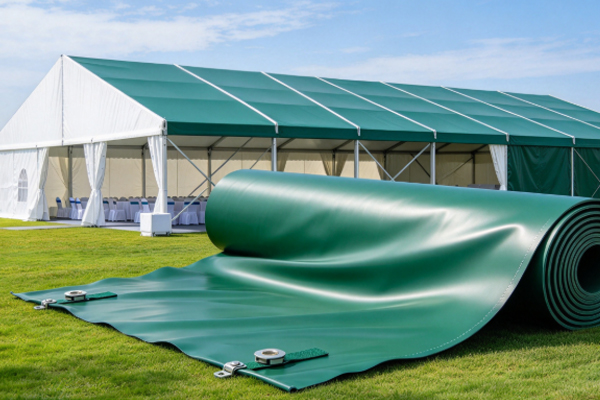
Tarpaulins are widely used for cargo transportation, warehouse covering, outdoor protection, vehicle covering, temporary shelters, and industrial rain protection systems. Effective rainwater protection depends not only on the waterproof performance of PVC tarpaulin and coated fabrics but also on the drainage design. If rainwater remains on the tarpaulin surface, accumulated water can increase the load on the fabric, causing sagging, deformation, and even local tearing over time. A practical tarpaulin drainage design should provide a clear path for rainwater to leave the surface while preventing concentrated water flow from damaging edges, seams, and fastening points. By adjusting the tarpaulin slope, establishing drainage routes, optimizing edge heights, positioning water outlets, and coordinating the supporting structure, the overall rain protection performance can be improved and stable long-term operation can be maintained.
The foundation of tarpaulin drainage design is to provide rainwater with a clear direction of flow. A completely flat tarpaulin surface is more likely to retain water, especially across large covering areas. As the accumulated water becomes heavier, the fabric may gradually sag and form low spots. These low areas then collect even more rainwater, creating a cycle that increases the risk of deformation. When designing a tarpaulin covering structure, a natural slope can be created by using differences in support height, crossbeam positions, or central support points. This allows rainwater to move from higher areas toward lower drainage points. For vehicle tarpaulins, the covering height can be adjusted according to the shape of the vehicle roof or cargo body. Warehouse tarpaulins can use single-slope or double-slope structures supported by frames, while temporary outdoor shelters can use curved or arched supports to guide rainwater toward both sides. Large tarpaulin structures may also need to be divided into several drainage zones so that excessive water does not collect at a single location. Slope design affects not only drainage efficiency but also fabric tension and structural stability, so it should be planned according to the actual dimensions and installation conditions.
For large tarpaulin structures or installations that remain in a fixed position, surface slope alone may not always provide sufficient drainage control. Additional drainage structures can guide rainwater toward designated outlets. Drainage channels can be positioned at lower sections of the tarpaulin, while folded edges, fixing strips, or drainage bands can be used to create continuous water-flow paths. The drainage route should not contain sudden height changes or excessively narrow sections, as concentrated rainfall may cause overflow. For large warehouse covering systems, continuous drainage zones can be arranged along the roof length and connected to external drainage facilities. For outdoor shelters, drainage strips can extend toward the edges so that water leaves the covered area efficiently. The drainage structure must also work with the tension of the tarpaulin. Excessive stress around drainage strips may lead to localized wear after long-term use. Coordinating drainage routes with the overall load-bearing structure helps reduce water accumulation and local deformation.
The edge of a tarpaulin is an important area where rainwater leaves the covered surface. If the edge is poorly designed, water may flow backward along the fabric and reach cargo, vehicles, or equipment. Depending on the installation environment, the edge can be extended, reinforced, or designed with a dedicated drip section to provide a more controlled water outlet. For cargo transportation tarpaulins, the edge should prevent rainwater from flowing toward the inside of the cargo compartment. Extending the tarpaulin outward can help direct water away from the cargo. For warehouse covering systems, the lower edge should be positioned appropriately in relation to gutters, downpipes, or other water collection equipment. Corners require particular attention because water from several directions may converge in the same area. Without sufficient drainage space, localized water accumulation can occur. After determining the outlet position, the tarpaulin edge should also be checked for folds, reverse bends, and local sagging, as these conditions may obstruct normal water flow.
Tarpaulin drainage cannot be achieved by designing the fabric surface alone. Fastening points, support poles, crossbeams, ropes, buckles, and other components must also work together with the drainage system. If fastening points are placed directly within a major drainage route, continuous water flow and tension may increase localized wear. Their positions can be adjusted to keep the main drainage path clear. For large tarpaulins, support spacing should also be controlled to prevent excessive sagging under the weight of rainwater.
The following methods can improve the overall structure:
Add support at critical positions: Central supports or auxiliary crossbeams can be added to large-span areas to reduce fabric sagging caused by accumulated rainwater.
Keep high-load fastening points away from major drainage routes: Buckles, straps, and connection components should be positioned so they do not block the main water-flow path.
Reinforce areas that are prone to water accumulation: Low points, corners, and connection areas can receive additional support to maintain a stable drainage shape.
Maintain balanced fastening tension: Excessively loose fabric may create water pockets, while excessive tension can increase stress around edges and eyelets. The appropriate tension should be selected according to the fabric and support structure.
Check how the support structure affects drainage: Crossbeams, support poles, and frames may change the shape of the tarpaulin, so the water-flow direction should be checked again after installation.
A well-designed fastening system helps the tarpaulin maintain its intended drainage shape, allowing rainwater to follow the planned route while reducing excessive localized stress.
Tarpaulins used in different applications have different sizes, installation methods, load conditions, and protection requirements, so the same drainage structure cannot always be used for every application. Cargo transportation tarpaulins need to prevent rainwater from entering the cargo area while supporting frequent loading and unloading. Warehouse tarpaulins generally cover larger areas and require stronger drainage capacity during prolonged rainfall. Vehicle protection tarpaulins need to follow the vehicle profile and guide water away from the body. Outdoor rain shelters need to provide effective drainage while maintaining usable space for people. Temporary construction tarpaulins also need to accommodate rapid installation, removal, and changes in site conditions.
Application | Recommended Drainage Structure | Design Focus |
Cargo transportation | Roof slope + external water guidance | Prevent water from entering the cargo area |
Warehouse covering | Continuous slope + drainage channel | Improve drainage across large areas |
Vehicle protection | Curved or sloped drainage | Adapt to vehicle contours |
Outdoor shelters | Arched structure + edge drainage | Reduce water accumulation on the roof |
Temporary construction | Quick water guidance + low-edge drainage | Allow easy installation and adjustment |
Equipment covering | Local slope + directional drainage | Prevent rainwater from contacting equipment |
Tarpaulin drainage design should also take local rainfall, available installation space, usage frequency, tarpaulin dimensions, and support conditions into consideration. For long-term PVC tarpaulin applications, the slope, edge structure, drainage outlet, and fastening system can be planned during the customization stage. For temporary tarpaulin installations, drainage performance can often be improved by adjusting support heights and fabric tension. During regular use, leaves, dust, and other debris should be removed from the surface, while the fabric should be checked for sagging, damage, water pockets, and blocked drainage paths. A well-planned drainage system reduces the time that rainwater remains on the tarpaulin, lowers the risk caused by prolonged water accumulation, and provides more stable rain protection for cargo, vehicles, equipment, and temporary covered spaces.
