
Hot Keywords:
- All
- Product Name
- Product Keyword
- Product Model
- Product Summary
- Product Description
- Multi Field Search

Tarpaulin sizes are not fixed or standardized specifications. They are selected according to the application, the object being covered, vehicle structure, and processing method. Common tarpaulins can be used for truck transportation, warehouse storage, construction, vessel covering, outdoor equipment protection, cargo yard covering, and other applications. Different uses also have different requirements for length, width, and edge allowance. When purchasing a finished tarpaulin, common specifications can usually be selected directly. If special-sized goods or vehicles need to be covered, the tarpaulin can also be customized according to actual measurements.
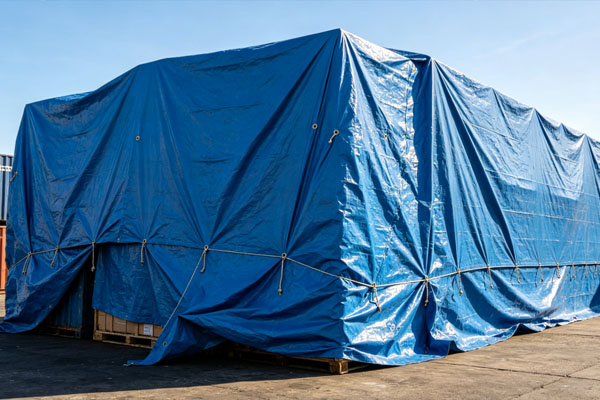
In actual selection, you should not only look at the length and width marked on the tarpaulin, but also pay attention to the difference between the finished size and the actual coverage size. Some tarpaulins need to hang down around the sides, some need to wrap around cargo, and some need to be fitted with grommets, rope loops, or D-rings. Therefore, the final finished size may need to be larger than the area being covered. PVC tarpaulins, canvas tarpaulins, and other coated tarpaulins are all tarpaulin products, but their material widths and processing methods are different, so their common sizes may also vary. Before choosing a size, it is best to measure the area that needs to be covered and then determine the specific specification based on the installation method.
Small tarpaulins are mainly used to cover small equipment, items, tools, timber, or temporary rain protection areas. Common specifications include:
2 meters × 3 meters
3 meters × 4 meters
3 meters × 5 meters
4 meters × 5 meters
These specifications have relatively small coverage areas and are convenient to transport, unfold, and store. For temporary covering, the size can be selected directly according to the actual dimensions of the item. If the covered object is relatively high, the tarpaulin should not be purchased based only on the top length and width. For example, if a piece of equipment measures 3 meters × 4 meters and has a height of 1 meter, the tarpaulin also needs to hang down around the sides, so the corresponding additional dimensions need to be considered.
Medium-sized tarpaulins are suitable for cargo covering, warehouse covering, construction sites, and some vehicle applications. Common specifications include: 4 meters × 6 meters, 5 meters × 6 meters, 6 meters × 8 meters, 6 meters × 10 meters, and 8 meters × 10 meters.
These sizes can cover relatively large items or cargo areas, but the specific selection still needs to take the covering height and fastening method into account. If the tarpaulin needs to hang down from the top of the cargo toward both sides, the required hanging length should be included in the calculation.
For cargo yards, vessels, large equipment, building materials, and other applications, tarpaulins measuring 8 meters × 12 meters, 10 meters × 15 meters, 10 meters × 20 meters, or even larger may be used. Extra-large tarpaulins usually need to be manufactured by splicing according to the width of the raw material. If the finished width exceeds the effective width available from a single sheet of material, multiple pieces need to be connected through heat sealing, welding, or other processing methods.
Truck tarpaulins are relatively common customized products. When selecting the size, the length, width, and height of the cargo bed need to be measured, while also determining how far the tarpaulin needs to hang down on both sides and at the front and rear. For example, if the cargo bed is 2.4 meters wide and the tarpaulin needs to hang down 0.8 meters on each side, the tarpaulin width should at least consider:
2.4 meters + 0.8 meters + 0.8 meters = 4 meters
If the bottom also needs to be tied down, an appropriate additional allowance should be added according to the fastening structure.
The size selection for vessel covering tarpaulins is more flexible. For a flat deck, the actual length and width can be measured. If the sides of the vessel also need to be covered, the required hanging dimensions on both sides should be added. If the bow and stern have curved shapes, measurements should also be taken along the actual coverage path. The maximum vessel length should not be used directly as the finished tarpaulin length, otherwise dimensional deviations may occur.
Cargo in a yard may be stacked to a certain height, so the tarpaulin needs to extend from the top to the sides. If the cargo is 1.2 meters high, simply selecting a tarpaulin based on the top area of the cargo will usually not provide complete coverage. You can first measure the length and width of the cargo top, then add the required hanging height around the sides while reserving enough space for fastening.
When purchasing a tarpaulin, you need to confirm whether the size provided by the supplier refers to the cutting size, finished size, or actual effective coverage size. Different processing methods may cause slight dimensional changes. If the tarpaulin is finished with edge binding, folding, or heat sealing, there may be some processing allowance around the edges. Therefore, it is best to confirm the specific dimensions before purchasing.
If grommets, rope loops, buckles, or other structures are installed around the tarpaulin, sufficient processing space needs to be reserved along the edges. In common situations, an appropriate allowance can be added outside the coverage area according to the actual installation requirements. For simple flat covering, each side can be increased by approximately 10–30 centimeters as a basic reference when needed. If the sides also need to be wrapped, the size should be recalculated according to the actual height.
A tarpaulin is not necessarily better just because it is larger. A tarpaulin that is too small will result in incomplete coverage, while one that is too large may create excessive loose material. In vehicle transportation, oversized tarpaulin edges can easily move around. When covering cargo, an oversized tarpaulin can easily form wrinkles and collect water. Therefore, the appropriate size should be based on complete coverage and convenient fastening.
There are many common specifications, such as 3 meters × 4 meters, 4 meters × 6 meters, 5 meters × 6 meters, 6 meters × 8 meters, 6 meters × 10 meters, and 8 meters × 10 meters. Specifications may vary among manufacturers, and large-sized products can also be customized according to requirements.
Usually, yes. For example, “6 meters × 8 meters” means that the tarpaulin is approximately 6 meters long and 8 meters wide. However, when purchasing, you should still confirm whether the manufacturer's stated size refers to the cutting size or finished size.
If it is only used for flat covering, it can cover an area close to 3 meters × 4 meters. However, if it needs to hang down around the sides, the actual top coverage area must be reduced because some of the material will be used to cover the sides.
Many tarpaulins can be cut, spliced, and processed according to requirements, but the final size will be affected by the raw material width, equipment processing range, and transportation conditions. Extra-large sizes usually require splicing.
Tarpaulin sizes range from small specifications to extra-large sizes. Sizes such as 3 meters × 4 meters, 4 meters × 6 meters, 5 meters × 6 meters, 6 meters × 8 meters, 6 meters × 10 meters, and 8 meters × 10 meters are relatively common. Large cargo yards, vessels, and equipment may also use large specifications such as 10 meters × 15 meters and 10 meters × 20 meters. The specific size should not be determined based on a single fixed specification. Instead, it should be selected according to the actual coverage area. For customizable products such as PVC tarpaulins, edge binding, grommets, rope loops, and reinforcement patches can also be added according to actual dimensions. If the finished size is large and exceeds the effective width of the raw material, heat sealing or welding needs to be used for splicing. Therefore, common specifications are suitable for quick selection, while special sizes are more suitable for customization based on actual measurements. Before purchasing, clearly determining the length, width, height, and application method can reduce problems caused by a tarpaulin being too small to cover the area or too large to fasten properly.
