
Hot Keywords:
- All
- Product Name
- Product Keyword
- Product Model
- Product Summary
- Product Description
- Multi Field Search

When customizing PVC tarpaulin ventilation ducts, dimensional information directly affects the manufacturing method, connection performance, and actual ventilation conditions of the duct. Unlike ordinary tarpaulin, ventilation ducts need to be manufactured according to air outlets, exhaust outlets, equipment connections, and installation space. If the dimensions provided are incomplete, even if the duct length and diameter basically meet the requirements, problems such as improper connections, difficult bending, installation difficulties, or unsatisfactory airflow at the end may occur after installation. Therefore, before placing an order for custom PVC tarpaulin ventilation ducts, it is necessary to prepare key data such as the installation location, duct diameter, overall length, connection dimensions, and elbow positions in advance.
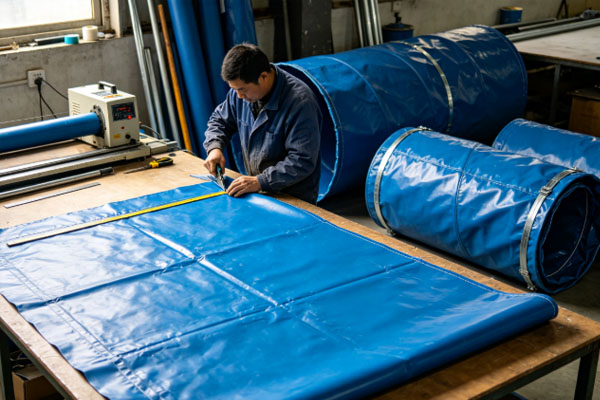
Different application scenarios also require different dimensional information. For example, PVC tarpaulin ventilation ducts used for temporary ventilation in factories, exhaust ventilation in warehouses, air supply in construction areas, tunnel ventilation, and ventilation in mining areas may have different diameters, lengths, and connection methods. Short flexible ducts may only require confirmation of the diameter and length, while long-distance ventilation ducts may also require sectional lengths, the number of connections, installation directions, and support positions. The more accurate the dimensions are, the easier it is to control the finished product specifications during production and reduce the need for modifications during on-site installation.
The duct diameter is one of the basic pieces of information required when customizing PVC tarpaulin ventilation ducts. Common round flexible ducts use diameter as the specification, such as 300mm, 400mm, 500mm, 600mm, 800mm, or larger sizes. The actual size should not be determined only according to the existing duct dimensions. It should also be confirmed based on the fan outlet, air supply equipment, and installation space. If the ventilation duct needs to connect directly to a fan, it is recommended to provide the actual outer diameter, inner diameter, or connection dimensions of the fan outlet and specify the measurement location. Some equipment connections are not standard round structures and may use flanges, clamps, or other connection methods. Therefore, providing only an approximate duct diameter may not be sufficient for manufacturing.
The length of a PVC tarpaulin ventilation duct cannot be calculated simply according to the straight-line distance between two pieces of equipment. During actual installation, the duct may need to pass around walls, supports, the tops of equipment, or other obstacles. Therefore, the length should be measured according to the actual installation route. It is recommended to provide the length of each section and mark the connection locations. If a ventilation line requires multiple duct sections, each section can be measured separately, making it easier to determine the number of joints and production dimensions.
If the ventilation duct connects to different pieces of equipment at both ends, the dimensions of both ends should be provided separately. For example, one end may connect to a fan while the other connects to an air outlet, and the two ends may use different specifications. In this case, the connection diameter, connection length, and connection method should be recorded separately. For products requiring flanges, clamps, zippers, or other fastening structures, the installation dimensions at the connection points should also be provided. This allows connection areas to be reserved during production and prevents situations where the finished duct meets the required duct dimensions but cannot be properly connected to the equipment.
If the PVC tarpaulin ventilation duct needs to bend, it is recommended to provide the bending direction, bending radius, and connection positions at both ends. For ventilation ducts installed in special spaces, the height, width, and distances between obstacles should also be marked. These dimensions can be shown through a simple site measurement drawing and do not necessarily require a complicated engineering drawing. As long as the drawing clearly indicates where the duct starts, where it passes, where it bends, and where it ultimately connects, it can help production personnel accurately understand the dimensional requirements.
When customizing ventilation ducts, the dimensional data is best organized in the format of “duct diameter + length + connections + special positions.” This makes communication easier and can reduce the need for repeated confirmation.
During measurement, tools such as tape measures or laser distance meters should be used to obtain actual dimensions whenever possible rather than estimating them based on equipment models. In particular, fan outlets, wall openings, and equipment connections may have dimensional differences of several millimeters or more, which can affect the connection performance. If an existing ventilation duct is already installed on site, its diameter, length, and connection dimensions can be measured directly, and the positions requiring modification can be recorded. If a new ventilation line is being installed, the duct route can be determined according to the equipment layout and available site space.
All dimensions should preferably be recorded using the same unit, such as millimeters or meters. For example, use “500mm” for the duct diameter and “8m” for the length rather than mixing different units in the same set of dimensional information. For connection dimensions, it should also be specified whether the measurement refers to the inner diameter or outer diameter. If the duct needs to connect to existing equipment, it is best to provide photos of the equipment connection along with marked dimensions. Photos can help identify the connection structure, while dimensional data serves as an important basis for manufacturing. Combining both can reduce misunderstandings.
Dimensions are not the only information that needs to be confirmed, but they are an important basis for determining the finished product specifications. PVC tarpaulin ventilation ducts usually need to be manufactured using appropriate tarpaulin thickness, color, abrasion resistance, and connection methods according to the application environment. Areas with high dust levels, construction sites, and long-term operating environments may have different requirements for material abrasion resistance and tensile strength.
For long-distance ventilation, multiple duct sections can be connected instead of manufacturing one extremely long flexible duct. A sectional design can reduce transportation and storage difficulties while also making on-site installation and maintenance easier. The length of each section should be determined according to the actual installation position, while the number of connections should also be confirmed. If the duct needs to be moved frequently, folding, rolling, and handling space should also be considered. PVC tarpaulin has a certain degree of flexibility, but as the size and length increase, manual handling and installation can become more difficult.
Some ventilation projects do not use the same diameter throughout the entire route but include connections between different diameters. If one end is 500mm and the other end connects to 400mm equipment, both end dimensions should be specified in advance rather than providing only one duct diameter. For products requiring tees, reducers, elbows, or branch ducts, the connection positions should also be marked on the dimensional drawing. This allows the dimensions of each component to be determined according to the overall structure during production.
These can be used as basic information, but for relatively simple PVC tarpaulin ventilation ducts, the connection methods at both ends usually also need to be confirmed. If there are bends, branches, diameter changes, or special installation positions, the corresponding dimensions also need to be provided. Otherwise, it may be difficult to accurately determine the finished product structure.
This depends on the actual connection method. It is recommended to provide both the inner and outer diameters of the fan outlet and specify whether the duct will be connected using a sleeve connection, clamp, flange, or another method. This makes it possible to determine the connection dimensions more accurately.
The straight-line lengths before and after the bend, bending direction, and approximate bending radius should be provided. If the site space is complicated, a simple sketch can be prepared with the duct diameter, length, bend location, and connection positions marked.
Yes. For standard ventilation ducts, a hand-drawn dimensional sketch, on-site measurement data, and photos of equipment connections can be used for explanation. The key is to ensure that the dimensions are clearly marked and that the units and measurement locations are specified.
When customizing PVC tarpaulin ventilation ducts, the dimensional information should be as close as possible to the actual installation conditions. The duct diameter determines whether the duct can connect properly to the fan and equipment, the length affects installation convenience, the connection dimensions affect fastening performance, and the dimensions of bends and diameter changes determine whether the duct can pass smoothly through special locations. For long-distance ventilation lines, sectional lengths and connection positions should also be planned in advance.
When preparing customization information, it can be recorded in the following order: “installation location — duct diameter — length of each section — connections at both ends — bend locations — diameter-change locations.” If there is no complete drawing available on site, a simple sketch can be used to explain the layout, supplemented with key dimensions and site photos. The clearer the dimensions are, the easier it is to determine material cutting, connection processing, and connection structures during production, reducing the possibility of dimensional problems after the finished product arrives at the site.
