
Hot Keywords:
- All
- Product Name
- Product Keyword
- Product Model
- Product Summary
- Product Description
- Multi Field Search

PVC tarpaulin is a flexible material made of fabric base material and a PVC coating. It is commonly used for cargo covering, industrial protection, construction, transport rain protection, equipment protection, and large flexible structures. The size that PVC tarpaulin can be made depends on factors such as the raw material width, production equipment, intended use, processing method, and splicing process. Standard PVC tarpaulin is usually produced in rolls, and the width of a single roll is limited by the coating equipment and base fabric specifications. When the required length or width exceeds the specifications of the raw material, heat sealing, welding, sewing, or other processes can be used for widening and connecting the material.
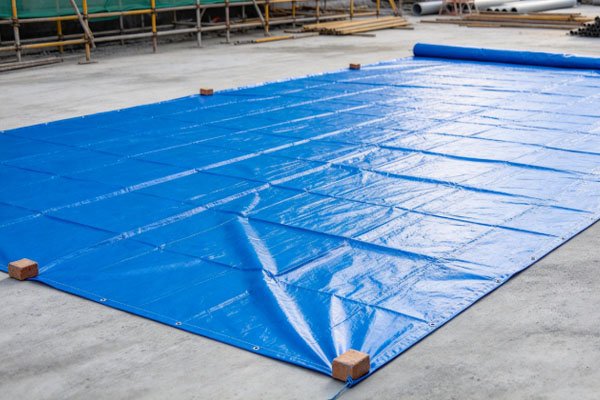
Therefore, large-size PVC tarpaulin does not necessarily need to rely on a single sheet of material to directly reach the final dimensions. For products such as large warehouse covers, vehicle tarpaulins, engineering protection covers, and industrial flexible structures, manufacturers usually cut, splice, and reinforce the material according to the actual dimensions so that the finished product can achieve a larger coverage area. It should be noted that as the tarpaulin size increases, the effects of its own weight, wind force, tension, and installation structure become more significant. Therefore, size design should not consider only length and width, but also determine the material thickness, seam structure, edge reinforcement, fastener positions, and fixing method at the same time.
During PVC tarpaulin production, processes such as base fabric weaving, PVC coating, calendering, or lamination are required. Therefore, the raw material usually has a certain effective width. Common PVC tarpaulin rolls can have different widths depending on the production equipment and product type, and the actual specifications are not completely uniform. The width that standard rolls can be directly processed into is limited. When a project requires wider tarpaulin, splicing is usually required to create a larger finished product.
The maximum single-sheet width of PVC tarpaulin is related to the production line equipment, coating process, base fabric structure, and material thickness. As the material becomes thicker and wider, tension control, coating uniformity, and winding become more difficult during production. Therefore, PVC tarpaulin on the market is usually available in different specifications according to different applications. It cannot simply be assumed that all PVC tarpaulin can be produced in any desired width.
When the actual required size exceeds the width of a single roll of material, heat sealing, high-frequency welding, or other methods can be used for connection. Properly processed seams can form a continuous waterproof structure, making them suitable for large covering tarpaulins and industrial protection products. As the number of splices increases, particular attention needs to be paid to seam strength, flatness, and waterproof performance to prevent excessive seams from affecting the stability of the finished product.
The maximum final size of PVC tarpaulin is directly related to the production method. Length is usually easier to extend than width because roll material can be continuously unfolded and cut. Once the width is limited by the raw material width, additional dimensions need to be created through splicing. During the production of large PVC tarpaulin, the cutting plan and seam layout need to be determined in advance rather than adding dimensions arbitrarily after the material has already been processed.
When a single sheet of PVC tarpaulin cannot meet the required width, multiple sections of material can be arranged according to the designed dimensions and then connected using heat-sealing equipment. The seams usually need to maintain sufficient overlap width, while the heat-sealing temperature, pressure, and speed should be adjusted according to the material thickness, PVC coating characteristics, and equipment parameters. Proper seam design can reduce the risk of water leakage, seam separation, and edge cracking.
Even if PVC tarpaulin can be processed into a very long size, the diameter, weight, and transportation conditions after winding need to be considered. If a large tarpaulin is too long, the finished product will become significantly heavier, making manual unfolding and installation more difficult. Therefore, large-size products usually need to determine reasonable sections according to the actual installation location rather than simply pursuing a larger single-piece size.
After the size of PVC tarpaulin is increased, its own weight and external forces will also increase. Especially in outdoor applications, wind can create continuous pulling forces on large-area tarpaulin. If the edges and fixing points are not reinforced, tearing, deformation, or fastener detachment may easily occur. Therefore, large-size PVC tarpaulin requires comprehensive design of the material, seams, and fixing structure.
The edges are usually important areas for installation, fixing, and bearing tension. Methods such as thickened edge binding, adding reinforcement strips, or installing metal fasteners can be used to improve load-bearing capacity. For products that are frequently unfolded and rolled up, the wear resistance of the edge material also needs to be improved to reduce damage caused by long-term friction.
Large PVC tarpaulin often contains long heat-sealed seams, and seam quality directly affects the stability of the finished product. During processing, the heat-sealing area needs to be kept clean, while equipment temperature, pressure, and movement speed need to be controlled. The seams should also be checked for incomplete welding, missed welding, bubbling, and local cracking. For products that bear relatively high tension, additional reinforcement layers can also be added according to the application to improve the strength of the connection area.
The width of a single sheet of PVC tarpaulin is usually limited by the raw material width and production equipment, so extra-wide products are generally not produced directly from a single sheet. When a project requires a very large width, multiple sections can be spliced together to increase the finished product size. The specific achievable width needs to be determined based on the material specifications, splicing equipment, operating environment, and final product structure.
Length usually provides greater processing flexibility, but this does not mean it can be increased indefinitely. As the length increases, material weight, winding dimensions, transportation difficulty, and installation difficulty also increase. For large engineering applications, reasonable sections need to be designed according to the site dimensions so that the finished product meets the coverage requirements while remaining convenient for transportation, unfolding, and fixing.
The risk of water leakage is mainly related to the material itself, seam processing, and operating conditions rather than size alone. If the splicing area is not sufficiently heat sealed, the overlap width is insufficient, or the seam is subjected to long-term stretching, water may penetrate through the seam. Therefore, large-size products need particular attention to heat-sealed seams and edge areas.
Not necessarily. Material thickness needs to be determined according to the operating environment, tensile requirements, wear resistance requirements, and fixing structure. If a large tarpaulin has a large wind-exposed area, overall stability can be improved by reasonably increasing material strength, reinforcement strips, edge structures, and fixing points. Simply increasing thickness cannot solve every problem.
The maximum size that PVC tarpaulin can achieve mainly depends on the raw material width, processing equipment, and splicing process. Standard specifications can be cut directly according to the roll dimensions, while extra-wide and extra-long products usually require heat sealing, welding, or other connection processes to expand the finished dimensions. Therefore, when determining the size of PVC tarpaulin, the actual coverage area should first be confirmed, followed by the development of a cutting and splicing plan based on the material specifications. Large-size PVC tarpaulin also requires attention to seam strength, edge reinforcement, fastener arrangement, and transportation conditions. As the size increases, the tarpaulin's own weight and wind-exposed area also increase, and the tension borne by the fixing structure increases accordingly. During production, heat-sealing temperature, pressure, speed, and overlap width need to be controlled, and the seams should be inspected to reduce problems such as incomplete welding, cracking, and water leakage. For large industrial protection, transport covering, and engineering covering products, reasonable size design should be determined together with material thickness, strength, and fixing structure. This allows the flexibility and protective performance of PVC tarpaulin to be fully utilized while reducing the risk of deformation or damage during transportation, installation, and long-term use.
