
Hot Keywords:
- All
- Product Name
- Product Keyword
- Product Model
- Product Summary
- Product Description
- Multi Field Search
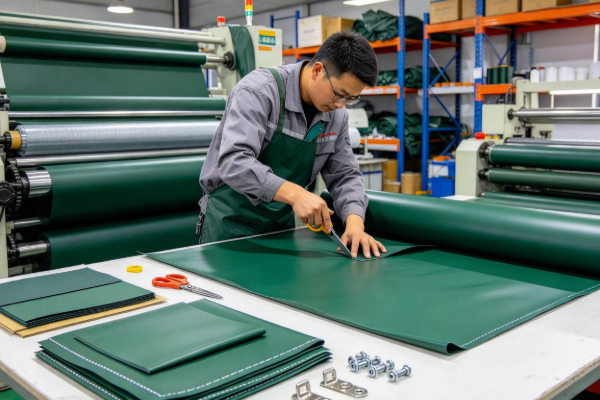
Custom PVC tarpaulins need to be designed according to the actual covering object, installation structure, and operating environment. Different applications have different requirements for dimensions, thickness, color, edge reinforcement, connection methods, and processing techniques. If key specifications are incomplete during the initial stage, problems such as incorrect dimensions, unsuitable eyelet positions, difficult installation, or material performance that does not match the working conditions may occur during production. Whether the product is intended for cargo transportation, vehicle covering, warehouse protection, outdoor shading, or temporary construction, clear customization data should be provided before manufacturing begins. Complete parameters help manufacturers understand the requirements accurately and develop a PVC tarpaulin design that is better suited to the actual application.
Dimensions are the most basic specifications in custom PVC tarpaulin production. Customers should provide the length and width of the unfolded tarpaulin, as well as the actual area that needs to be covered. When the product is used for vehicles, cargo boxes, or equipment protection, the length, width, and height of the covered object should also be provided. This helps determine whether the tarpaulin needs additional hanging sections, hem allowances, or installation clearance. Rectangular tarpaulins can generally be specified using length and width measurements, while products with sloped edges, rounded corners, curved sections, or openings require additional dimensional information for these areas.
For large custom tarpaulins, providing only the overall dimensions may not be sufficient. It is also useful to specify whether the product can be made from multiple panels and what the required finished dimensions are after welding. If the tarpaulin will be installed on a fixed frame, customers can provide frame dimensions, support locations, and installation-area drawings. Clear dimensional information makes cutting, heat welding, and subsequent processing more accurate. For products with unusual shapes, a simple sketch, CAD drawing, or photograph with marked measurements can also help production teams understand the required outline more precisely.
PVC tarpaulins are available in different material specifications. Base fabric construction, PVC coating thickness, overall weight, and flexibility can vary according to the intended application. During customization, the material should be selected according to the actual working conditions. For example, ordinary cargo covering may prioritize waterproofing, abrasion resistance, and tensile strength, while long-term outdoor applications may require better weather resistance, UV resistance, and stability under temperature changes.
The following specifications can be confirmed during the customization process:
Tarpaulin thickness: Select an appropriate thickness according to the application and structural requirements. Thickness affects weight, flexibility, and abrasion resistance.
Material weight: The weight per unit area helps estimate the finished product weight and transportation or handling requirements.
Base fabric construction: Select a suitable fabric structure according to tensile strength and expected loads.
Surface performance: Waterproofing, stain resistance, abrasion resistance, and weather resistance can be specified according to operating conditions.
Color specification: Provide a standard color, designated color code, or physical sample to maintain consistency between products.
Special performance: For specialized environments, requirements such as flame resistance, anti-static properties, or low-temperature resistance can be specified in advance.
Material specifications should match the actual application. An excessively lightweight material may not withstand frequent abrasion or high tension, while an overly thick material can increase product weight and make folding or handling more difficult. The material combination should therefore be selected according to the actual working conditions.
After the PVC tarpaulin is cut, additional processing such as hemming, eyelet installation, webbing reinforcement, or D-ring installation is usually required. Connection structures have a direct impact on installation, so customization specifications should include the number of eyelets, hole diameter, spacing, edge distance, and connector type. If the tarpaulin needs to connect with vehicle hooks, frames, ropes, or other fastening devices, information about the existing installation structure should also be provided.
For example, a vehicle tarpaulin may require eyelets to match hooks positioned along the cargo body. An outdoor covering tarpaulin may need reinforced corners with D-rings, while a large warehouse cover may use continuous webbing to improve edge load distribution. For products that are frequently removed and installed, customers can specify quick-release buckles, elastic cords, or other rapid connection systems. Providing installation drawings or photographs of existing connection components can also help manufacturers determine how different components should work together.
The edge structure should also be coordinated with the overall tarpaulin dimensions. Eyelets positioned too close to the edge may reduce local strength, while excessive distance can make installation inconvenient. Too few connectors may result in unstable coverage, while excessive connectors can increase processing costs. Connection parameters should therefore be determined according to the actual installation structure.
PVC tarpaulins with identical dimensions may require different materials and processing methods when they are used in different environments. In addition to dimensions and material specifications, customers should describe where the tarpaulin will be used and how frequently it will be operated. For cargo covers, it is useful to specify whether the tarpaulin will protect ordinary goods, machinery, or unusually shaped cargo. For vehicle applications, the vehicle type, cargo-body dimensions, and installation method can also be provided.
Useful application information includes:
Installation location: Specify whether the tarpaulin will be installed on a vehicle body, cargo box, warehouse, frame, equipment surface, or another structure.
Usage frequency: Indicate whether it will remain permanently installed, be removed periodically, or be opened and closed frequently.
Environmental conditions: State whether the product will be exposed to sunlight, rain, wind, dust, low temperatures, or high temperatures.
Load conditions: Describe exposure to strong wind, repeated pulling, cargo abrasion, localized pressure, or other mechanical loads.
Maintenance requirements: Specify whether the product will require frequent cleaning, folding, rolling, or transportation.
Special restrictions: Mention any limitations involving available space, product weight, color, installation tools, or other site conditions.
This information helps manufacturers determine suitable material thickness, edge reinforcement, and connection structures so that the customized tarpaulin better matches actual operating habits.
In addition to the tarpaulin's basic specifications, customization orders should clearly define the required processing methods and delivery conditions. These may include heat-welded seams, hems, eyelets, D-rings, webbing reinforcement, special openings, or transparent windows. For large tarpaulins made from multiple panels, the seam positions and finished dimensions after welding can be confirmed in advance. Products with doors, zippers, or quick-opening structures should also include the required opening dimensions and opening direction.
Customization Parameter | Required Information | Main Purpose |
Finished dimensions | Length, width, height, or outline measurements | Determine cutting specifications |
Material specification | Thickness, weight, base fabric construction | Determine material performance |
Color | Color code or physical sample | Maintain appearance consistency |
Eyelet specifications | Quantity, hole diameter, spacing | Determine fastening positions |
Edge structure | Hem, webbing, reinforcement patches | Improve edge stability |
Connection method | D-rings, buckles, ropes, etc. | Match installation equipment |
Seam requirements | Welding positions, seam width | Manufacture large tarpaulins |
Special processing | Openings, zippers, transparent windows, etc. | Provide customized functions |
Application conditions | Indoor, outdoor, vehicle, etc. | Match the operating environment |
Packaging, folded dimensions, order quantity, and transportation requirements can also be confirmed before delivery. For customers purchasing in larger quantities, it is useful to establish sample approval standards and dimensional tolerances in advance so that future production batches have clear reference specifications.
The more complete the data provided for custom PVC tarpaulin design, the easier it is to maintain consistency throughout manufacturing. Customers can prepare finished dimensions, shape drawings, material specifications, colors, eyelet positions, edge structures, connection methods, operating conditions, and special processing requirements in advance. For products with complex structures, site photographs, installation sketches, or dimensioned drawings can also be supplied. Clear specifications help manufacturers select suitable PVC tarpaulin materials and processing methods while reducing later modifications and improving coordination between dimensional accuracy, installation convenience, durability, and practical performance.
