
Hot Keywords:
- All
- Product Name
- Product Keyword
- Product Model
- Product Summary
- Product Description
- Multi Field Search

The orientation of PVC ventilation duct material during processing and installation can affect the surface wear resistance, cleaning performance, sealing performance, and long-term service condition of the duct. Common PVC-coated fabrics usually consist of a base fabric and a PVC coating. Some products have a single-sided coating, while others have a double-sided coating. Therefore, the front and back sides of the material should first be confirmed before installation. If the performance of both sides is basically the same, the effect of orientation is relatively small. If one side is smoother, more wear-resistant, or has a special coating, the direction should be determined according to the intended use of the product. For flexible ventilation ducts used to convey air, welding fumes, dust, or equipment exhaust, the inner surface is also in direct contact with continuously flowing air, so particular attention should be paid to the smoothness of the inner surface and the resistance encountered by the airflow. Correctly determining the material orientation can reduce installation errors and help maintain stable duct operation.
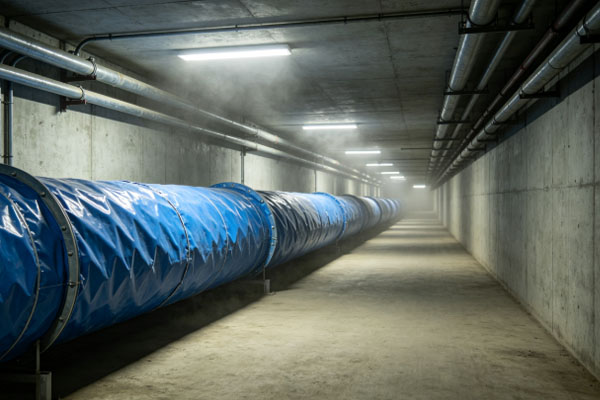
The orientation of PVC ventilation duct material needs to be determined according to the specific fabric structure. If single-sided PVC-coated fabric is used, the smoother side with a more complete PVC coating is generally placed toward the inside of the duct, allowing the air to directly contact the relatively smooth coated surface, while the side with a more visible and coarser base-fabric texture faces outward. This practice mainly considers the airflow contact surface, ease of cleaning, and material protection, but not every product must be installed in this direction.
If one side is noticeably smooth while the other side shows a more visible fabric texture, the smooth PVC-coated surface can generally be used as the inner side of the ventilation duct when there are no specific product requirements. A smooth surface is less likely to have obvious fiber protrusions and is also relatively easy to clean when dust, oil, and other substances accumulate on the duct wall. However, some PVC tarpaulins are designed with double-sided coatings, providing good water resistance and wear resistance on both sides. Some industrial duct materials also use different formulations for the inner and outer surfaces. Therefore, when customizing PVC ventilation ducts, the material specifications and processing instructions provided by the supplier should be followed.
Before PVC ventilation duct material is cut and processed, its front and back sides should first be identified. Different PVC-coated fabrics have different structures. Some materials have an obvious PVC coating on only one side, while others use a coating on both sides. Therefore, the orientation cannot be determined using only one fixed method. During on-site inspection, the material can be unfolded and both sides observed in their natural condition, paying attention to color, gloss, fabric texture, and coating integrity. If the material is clearly marked with front and back sides, the markings provided by the supplier should be followed during processing. If there are no obvious markings, the following areas can be considered:
Observe the coating surface: The side with a more complete PVC coating is usually smoother and has a more obvious plastic-like appearance, with less visible base-fabric texture. This side is generally more suitable as the air-contact surface.
Check the base-fabric texture: If the woven fabric texture is clearly visible on one side while the other side is relatively smooth, the side with the obvious fabric texture can usually be identified as the base-fabric side. However, the actual inner and outer orientation should still be determined according to the intended use of the material.
Check wear-resistant areas: Some industrial PVC materials are treated for higher wear resistance on a specific surface. If the product information specifies that one side has higher wear resistance, the orientation should be determined according to the actual contact conditions of the ventilation duct.
Confirm the product specifications: For PVC ventilation materials designed for high-temperature resistance, oil resistance, antistatic performance, or chemical resistance, the front and back sides should not be determined solely by appearance. The material specifications and processing requirements provided by the supplier should be used as the basis.
After the material orientation has been determined, it is recommended to maintain a consistent direction during cutting, especially when producing PVC ventilation ducts with the same specifications in batches. Some duct sections should not have the front side facing inward while others have the back side facing inward. Consistent orientation helps maintain continuity of the internal duct surface and also makes subsequent inspection, cleaning, and maintenance easier.
The orientation of PVC ventilation duct material affects not only the installation appearance but also heat sealing, bending, connections, and long-term operating conditions. Flexible ducts generally undergo cutting, joining, heat sealing, or stitching during production. If the front and back sides are not kept consistent, the processing results at some connections may differ. For industrial ventilation ducts that require good sealing performance, the condition of the material surface is particularly important. Once the material orientation has been determined, it should remain consistent throughout the entire processing process to avoid having the smooth side facing inward in some sections and outward in others of the same duct.
When air flows through a PVC ventilation duct, it continuously contacts the duct wall. If the inner surface contains obvious wrinkles, excessive folds, or processing burrs, local airflow resistance may increase. Therefore, after determining the material orientation, the duct forming quality also needs to be controlled. For large-diameter flexible ducts, severe twisting during installation should be avoided. Even when the material orientation is correct, significant twisting may affect the effective ventilation cross-section.
After PVC material is connected through heat sealing or other processing methods, the seams become part of the duct structure. If the front and back sides of the material are mixed, some connection areas may have inconsistent surface conditions. Therefore, the material orientation can be marked during cutting. This is particularly useful when producing PVC ventilation ducts with the same specifications in batches, as it makes it easier to maintain product consistency.
Not necessarily. For single-sided PVC-coated material, if one side clearly has a complete PVC coating while the other side mainly shows the base-fabric texture, the smooth coated surface can generally be placed on the inner side. However, if double-sided PVC-coated fabric is used and the performance of both sides is similar, there is no absolutely fixed inner or outer direction. The final orientation should be determined according to the material structure and the supplier's product requirements.
It will not necessarily affect ventilation immediately, but it may affect the cleanliness, wear resistance, and long-term service condition of the duct's inner surface. If both sides have similar performance, the actual effect may be relatively limited. If one side has a dedicated wear-resistant, oil-resistant, or other functional coating, installing it in the wrong direction may prevent the designed performance from being fully utilized.
If both sides have PVC coatings and the product information does not specify a fixed inner or outer direction, the installation direction can be determined according to processing convenience, while maintaining a consistent orientation throughout the entire duct. For materials designed for special applications, the specific specifications should be checked instead of determining the direction solely from the surface appearance.
It is not recommended to determine the orientation based only on color. Differences in color may sometimes result from production processes, surface treatments, or different material batches, and do not necessarily indicate the front or back side of the material. The coating, base fabric, surface texture, and product specifications should all be considered when determining the orientation.
There is no absolute orientation requirement that applies to every type of PVC ventilation duct material. For common single-sided PVC-coated fabric, if one side is smooth and the other has an obvious base-fabric texture, the smooth PVC-coated surface can generally face the inside of the duct when there are no specific product requirements, allowing the air to contact the relatively smooth coated surface. For double-sided PVC-coated materials, the orientation should be determined according to the product structure.
During actual purchasing and processing, the base-fabric structure, coating method, thickness, temperature resistance, wear resistance, and conveyed medium of the PVC material should be confirmed in advance, and the side to be used as the inner surface of the duct should be clearly identified. For industrial ventilation ducts used to convey welding fumes, dust, oil mist, or special gases, suitable PVC material should be selected according to the actual operating conditions. Once the orientation has been determined, consistency should be maintained throughout cutting, heat sealing, and installation to reduce processing errors and help maintain continuity of the internal duct surface. If the supplier has provided clear front-and-back markings or processing requirements, the product's technical requirements should take priority rather than relying only on the appearance of the material.
