
Hot Keywords:
- All
- Product Name
- Product Keyword
- Product Model
- Product Summary
- Product Description
- Multi Field Search

Truck tarpaulins are customized products based on the vehicle structure, cargo compartment dimensions, and fastening method. Whether the dimensions are measured accurately will directly affect the tarpaulin's coverage, installation difficulty, and protective performance during transportation. Especially for customized PVC tarpaulins, truck waterproof tarpaulins, or tarpaulins equipped with rope loops, fasteners, elastic bands, and other fastening structures, it is not enough to measure only the length and width of the cargo compartment. The compartment height, top structure, edge positions, and spacing between fastening points should also be recorded.
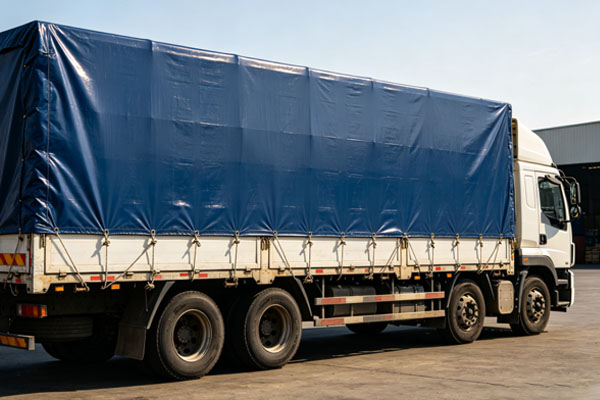
Different types of trucks have different cargo compartment structures. For example, flatbed trucks, high-sided trucks, box trucks, semi-trailers, and engineering transport vehicles do not use exactly the same tarpaulin installation methods. If the tarpaulin is made only according to the vehicle's stated dimensions, the finished product may have insufficient coverage, overly long edges, difficult fastening, or uneven tension. Therefore, before placing a custom order, it is recommended to use a measuring tape for on-site measurement and record the results clearly in centimeters or millimeters. For truck tarpaulins that need to be frequently installed and removed, the fastening method should also be determined in advance, with suitable space reserved for fasteners and ropes.
The length and width of the cargo compartment are important data for calculating the basic dimensions of the tarpaulin. During measurement, do not rely only on the vehicle nameplate or standard parameters provided by the manufacturer. Measure the actual installation area directly.
Cargo compartment length: Measure from the front end of the cargo compartment to the rear end, paying attention to any protruding structures.
Cargo compartment width: Measure the actual distance between the left and right sides of the coverage area.
Cargo compartment height: For high-sided trucks, measure the height of the side panels from the bottom to the top.
Top width: If the vehicle has curved frames, support bars, or other top structures, measure the highest position and the width between both sides.
For flatbed trucks, if the tarpaulin needs to hang down from the top of the cargo platform to both sides, the required hanging length should also be measured. This dimension affects whether the cargo can be fully covered and also determines the bottom fastening position.
Some trucks do not have a standard rectangular structure. Guardrails, posts, side panels, toolboxes, or other accessories may be installed on both sides of the cargo compartment. These structures should be recorded during measurement. If the tarpaulin needs to pass around fixed structures on both sides of the vehicle, measure the distance from each protruding object to the edge of the cargo compartment. For vehicles with curved roofs, the roof curvature or the dimensions between support frames should also be measured to avoid making the tarpaulin directly according to flat dimensions.
Truck tarpaulins usually cannot be cut exactly according to the length and width of the cargo compartment because the tarpaulin needs to cover the cargo and leave additional space around the edges for fastening. For example, if the cargo compartment is 6 meters long, the tarpaulin may need additional coverage at the front and rear ends; if the cargo compartment is 2.4 meters wide and the tarpaulin needs to hang down on both sides, additional length is also required. Therefore, the final tarpaulin dimensions are usually larger than the actual cargo compartment dimensions.
During measurement, the following dimensions can be recorded separately: Actual cargo compartment dimensions + coverage allowance + fastening hem or installation area
This makes it easier to determine the finished product dimensions later.
If the tarpaulin is secured with rope loops, D-rings, hooks, fasteners, or elastic bands, the positions of the fastening points should be measured in advance. The distance between fastening points affects the tension of the tarpaulin. If there are too few fastening points, the tarpaulin may swing significantly during driving; if the fastening points are too close together, processing costs and installation time may increase. Therefore, the fastening positions should be determined according to the vehicle structure, and the spacing between the front, rear, left, and right fastening points should be recorded. For trucks that already have fastening rings installed, the distance between the rings can be measured directly, with the positions of the first and last fastening points clearly marked. This allows the fasteners on the tarpaulin to correspond with the vehicle during production.
The main measurement points for flatbed trucks are usually the length and width of the cargo platform, the maximum cargo loading height, and the required tarpaulin hanging length on both sides. If the cargo height varies frequently, the tarpaulin should be designed according to the common maximum loading height with reasonable coverage space reserved.
High-sided trucks require additional measurement of the side panel height. The tarpaulin must cover not only the top but also extend downward along the side panels, so measuring only the top area of the cargo compartment is not sufficient. If there are posts, locks, or other protruding structures on the side panels, their positions should also be measured. Otherwise, the tarpaulin may become stuck or experience concentrated tension after installation.
Large vehicles use larger tarpaulins, so the impact of dimensional errors is also more significant. In addition to length, width, and height, the tarpaulin roll-up position, support frame spacing, and side fastening points should also be measured. If the vehicle uses a sliding tarpaulin structure, measurements should be taken according to the positions of the rails, supports, and rollers. These tarpaulins cannot simply be produced according to standard truck tarpaulin dimensions.
Usually, this is not recommended. Length and width only determine the basic coverage area. They do not determine the required side overhang, front and rear allowance, or fastener positions. If the vehicle has high side panels, support frames, or fastening rings, additional dimensions are required.
No. An oversized tarpaulin may cause edge folding, difficult fastening, and excessive movement while driving. An undersized tarpaulin cannot fully cover the cargo. The appropriate dimensions should be determined according to the cargo compartment structure, cargo height, and fastening method.
This depends on the actual tarpaulin installation position. If the tarpaulin covers the outside of the cargo compartment, the external coverage dimensions should generally be used as the basis. If it is installed inside a specific support frame or rail system, measurements should be taken according to the actual installation structure.
After completing the measurement, it is recommended to check the data again, especially the length, width, height, and fastening point spacing. For large tarpaulins, measurements can be taken separately from the front, rear, left, and right sides to confirm whether there are slight dimensional differences in the vehicle. If an old tarpaulin is already installed, it can also be laid flat and measured, then compared with the actual vehicle structure for adjustment.
Custom truck tarpaulin dimensions need to be determined according to the cargo compartment structure, loading height, coverage area, and fastening method. Basic measurement should at least include the length, width, and height of the cargo compartment. For high-sided trucks, flatbed trucks, or transport vehicles with support frames, additional measurements are required, including the tarpaulin overhang length, top structure, post positions, fastening ring spacing, and front and rear allowance. Only when these dimensions are sufficiently complete can the risk of an unsuitable finished size be reduced. During measurement, it is recommended to use a steel measuring tape and keep it horizontal or vertical to avoid errors caused by diagonal measurement. For long cargo compartments, two people can work together, with one person holding the measuring tape and the other reading the measurement. When recording the data, it is best to use centimeters or millimeters consistently rather than mixing different units. If the vehicle has a complex structure, photos of the top, sides, rear, and fastening positions can be taken and provided to the tarpaulin manufacturer together with the dimensional data. In addition to dimensions, the tarpaulin thickness, color, edge finishing method, fastener type, rope loop spacing, and whether reinforced areas are required should also be confirmed in advance. For vehicles that transport cargo frequently, it is recommended to keep a complete measurement record. When the tarpaulin needs to be replaced later, the record can be checked directly, reducing errors caused by repeated measurements.
