
Hot Keywords:
- All
- Product Name
- Product Keyword
- Product Model
- Product Summary
- Product Description
- Multi Field Search

Large tarpaulins are commonly used for truck transportation, vessel covering, construction, warehouse covering, outdoor equipment protection, and rain protection for large cargo. Compared with ordinary small-sized tarpaulins, large tarpaulins are heavier, cover longer distances, and have a wider load-bearing range after installation. When used outdoors, tarpaulins are also continuously exposed to wind, rain, rope tension, and friction from the edges of cargo. If the entire tarpaulin relies only on a single layer of fabric to withstand these forces, local deformation, edge tearing, eyelet damage, or seam cracking may occur after long-term use.
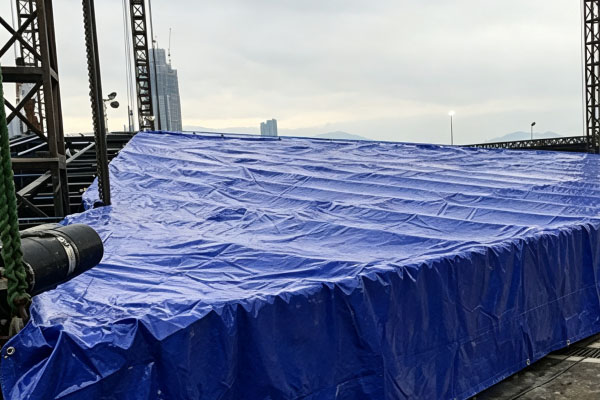
Reinforcing ribs are a structural treatment designed to strengthen these load-bearing areas. They are usually created by adding reinforcing tapes, thickening the material, or installing reinforcing strips, allowing the tension originally concentrated in one location to be distributed over a larger area. Reinforcing ribs are not simply intended to increase thickness, but to improve the stress conditions of the tarpaulin during unfolding, fastening, and use. In particular, the surrounding edges, eyelet areas, corners, splicing seams, and areas that are prone to friction require reinforcement according to the actual application. Properly designed reinforcing ribs can improve the tear resistance of the tarpaulin and reduce deformation caused by long-term use.
After a large tarpaulin is unfolded, it creates a large wind-facing area. When used on vessels, trucks, and open-air cargo yards, the wind continuously acts on the tarpaulin surface. If there are only a few fastening points, the wind force may be concentrated on several eyelets and edge areas. As the tarpaulin repeatedly moves with the wind, local areas are subjected to repeated pulling, which may eventually cause tearing.
The larger the tarpaulin, the greater its overall weight usually is. During installation, if the tarpaulin needs to hang down from the top, the weight of the fabric continuously acts on the fastening points. If eyelets, rope loops, or D-rings are installed around the tarpaulin, these areas will bear noticeable tension. Reinforcing ribs can help expand the load-bearing area of these sections and reduce concentrated tension on individual fastening points.
The reinforcing ribs of large tarpaulins are usually not evenly distributed across the entire sheet. Instead, they are designed according to the actual load-bearing areas.
Tarpaulin edges: Used to strengthen the hemmed areas and reduce tearing caused by pulling.
Eyelet and rope loop areas: Reduce material damage around fastening components.
Four corners: Corners often need to be tightened and are areas where stress concentration is more likely to occur.
Areas near splicing seams: After large tarpaulins are heat-sealed or welded, additional reinforcing materials can be added according to the application requirements.
The tension in these areas is usually more concentrated, so reinforcement can improve overall stability during use.
For especially large tarpaulins, reinforcing only the edges may sometimes not be sufficient. If the tarpaulin has a large span, the middle area may also experience noticeable movement when exposed to wind. For these products, longitudinal or transverse reinforcing ribs can be designed according to the supporting structure. For example, if a tarpaulin covers large cargo with support frames underneath, reinforcing tapes can be positioned according to the support frames to distribute the load more evenly. The positions of the reinforcing ribs need to be determined according to the actual structure, and more reinforcement is not always better. Excessive reinforcing materials can increase the weight and may also affect folding and storage.
When a tarpaulin is fastened, the fastening components transfer tension to the fabric. Without reinforcement, excessive tension may become concentrated around the eyelets, gradually causing material deformation. After reinforcing ribs are added, the tension can spread over a larger area, reducing the load at a single point. This design is especially important for tarpaulins that are frequently installed and removed.
Tarpaulin edges usually need to accommodate eyelets, rope loops, or other fastening components. If the edge material is too thin, it may deform under long-term tension. Reinforcing ribs can be used together with the hem structure to help maintain the shape of the tarpaulin edges while reducing direct pulling on the fabric from fastening components.
Large tarpaulins have a large surface area and are prone to moving up and down or from side to side when exposed to wind. Properly positioned reinforcing ribs and fastening points can help keep the tarpaulin more stable. However, reinforcing ribs cannot replace proper fastening methods. During installation, fastening points still need to be arranged according to the tarpaulin size, environmental wind conditions, and support structure.
Not necessarily. The number of reinforcing ribs needs to be determined according to the tarpaulin size, material thickness, application environment, fastening method, and main load-bearing areas. Larger tarpaulins generally require reinforcement in more load-bearing areas, but the number should not simply be increased.
Not all PVC tarpaulins require reinforcing ribs. Small-sized temporary covering tarpaulins with low loads may not require special reinforcement. However, reinforcement is generally more necessary for large outdoor tarpaulins, truck tarpaulins, vessel tarpaulins, and products intended for long-term fixed use.
No. Reinforcing materials need to match the thickness, flexibility, and processing method of the tarpaulin itself. If the reinforcing material is too thick, it may increase the weight of the tarpaulin and make folding and installation more difficult.
Eyelets are the connection points between the tarpaulin and ropes, hooks, or fastening rings, and they bear relatively high tension during use. Without reinforcement, the areas around the eyelets may expand, deform, or even tear. Therefore, large tarpaulins generally need additional reinforcing materials around the eyelet areas.
The main purpose of using reinforcing ribs on large tarpaulins is to improve the load-bearing condition of the tarpaulin. Since large tarpaulins have a large surface area, fastening points, edges, corners, and splicing areas are prone to stress concentration. If these areas are continuously affected by wind, ropes, and friction, tearing, deformation, or eyelet damage may occur. Reinforcing ribs can expand the load-bearing area and distribute tension that is concentrated in local sections, thereby improving the durability of the tarpaulin. When customizing large PVC tarpaulins, the positions of the reinforcing ribs usually need to be designed according to the tarpaulin size and installation structure. Continuous reinforcing tapes are suitable for the surrounding edges, local reinforcement can be added around eyelets and rope loops, and higher-strength reinforcement can be used at the four corners. If there is a support frame in the middle of the tarpaulin or if the tarpaulin is exposed to strong wind for long periods, transverse or longitudinal reinforcing ribs can also be added according to the support structure.
