
Hot Keywords:
- All
- Product Name
- Product Keyword
- Product Model
- Product Summary
- Product Description
- Multi Field Search

When PVC tarpaulin is exposed to high temperatures, its dimensions may indeed change to some extent, but the degree of change is not fixed. PVC tarpaulin is a flexible composite material made of a fabric base and PVC coating. It is commonly used for cargo covering, vehicle transportation, construction, industrial protection, equipment covering, and flexible ventilation ducts. When the material is exposed to a short period of temperature increase within its normal operating temperature range, it usually does not immediately show obvious permanent dimensional changes. However, when the environmental temperature continues to rise, or when the material is also subjected to stretching, compression, fixing, and wind forces, changes may occur in its length, width, and local shape. The PVC coating may change in softness after being heated, while the fabric base may also undergo a certain degree of thermal shrinkage or thermal expansion. Different material structures have different dimensional stability.
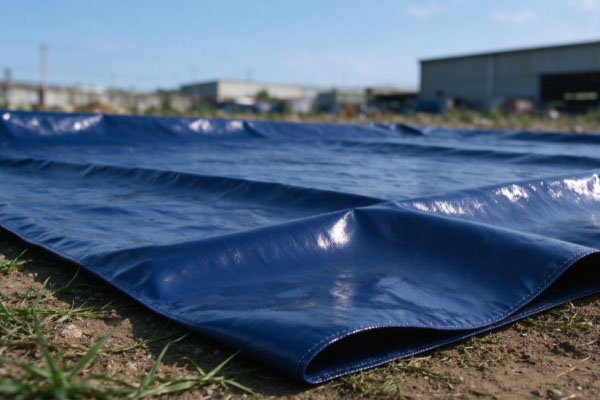
The effects of high temperatures are also related to heating time, temperature level, material thickness, base fabric type, PVC formulation, production process, and installation condition. After short-term heating, some dimensional changes may recover when the tarpaulin cools back to normal ambient temperature. Long-term exposure to continuous high temperatures may accelerate the aging of the PVC coating, gradually changing the material's flexibility, tensile performance, and dimensional stability. In particular, dark-colored tarpaulin exposed to direct sunlight may have a surface temperature significantly higher than the surrounding air temperature. If the tarpaulin has a large area and is tightly fixed, the expansion and contraction caused by temperature changes will be restricted by the fixing structure, resulting in local stress. Therefore, determining whether PVC tarpaulin will experience dimensional changes after exposure to high temperatures requires analysis based on material properties and actual operating conditions, rather than judging only by ambient air temperature.
After PVC tarpaulin is heated, the PVC coating and fabric base inside the material may respond to heat to different degrees. PVC is a thermoplastic material, and temperature changes can affect its softness and dimensional condition. The fabric base is affected by factors such as fiber type, weaving structure, and production process. When the tarpaulin is in a free state, the material can release some of the stress caused by temperature changes through slight expansion and contraction, so the change may not be obvious visually. When the tarpaulin has already been fixed to a vehicle, support, frame, or equipment surface, its freedom to expand and contract is restricted, and temperature changes may be converted into tensile or compressive stress.
PVC tarpaulin is not a material that completely avoids thermal expansion and contraction. After the temperature rises, the PVC coating and base fabric may experience a certain degree of dimensional change, but the actual direction and magnitude of the change need to be determined according to the material structure. Some materials may experience slight expansion after heating, while certain woven base fabrics treated with specific setting processes have good dimensional stability and relatively limited changes. If the tarpaulin uses a high-strength woven base fabric and undergoes proper coating and setting processes, it generally has good dimensional stability within its normal operating temperature range. If the material remains at a relatively high temperature for a long period, or if the operating temperature approaches the material's allowable range, dimensional changes may gradually become more noticeable. This is especially important for large-area tarpaulin. Even if the change per unit length is small, it may result in a noticeable length difference when accumulated over a long dimension.
Short-term heating and long-term high-temperature use do not produce exactly the same results. After short-term heating, some dimensional changes caused by thermal expansion may recover when the tarpaulin cools to normal temperature. If the material only occasionally experiences high temperatures and the temperature does not exceed its applicable range, obvious permanent deformation usually does not occur immediately. Long-term exposure to high temperatures is different. The PVC coating may gradually age, and the material's flexibility, tensile performance, and surface condition may change. If ultraviolet exposure, mechanical friction, or continuous tension also occurs, material aging may accelerate further. At this point, dimensional changes may no longer be caused simply by thermal expansion and contraction, but may also be related to changes in material properties.
During actual use, PVC tarpaulin may experience day-and-night temperature differences, seasonal temperature differences, and temperature changes caused by equipment startup and shutdown. Repeated heating and cooling cause the material to undergo continuous minor expansion and contraction. If the tarpaulin remains under fixed tension for a long period, seams, fastener holes, and edge areas may repeatedly experience stress. Over time, local areas may develop looseness, deformation, or slight wrinkles. Therefore, in environments with frequent temperature changes, it is necessary to consider not only the maximum temperature but also the frequency of temperature changes and whether the tarpaulin is under continuous load.
The dimensional stability of PVC tarpaulin in high-temperature environments is jointly affected by the base fabric, coating, processing technology, and actual operating conditions. PVC tarpaulin of the same size may behave differently after heating if different types of woven base fabrics, coating thicknesses, or processing methods are used. Therefore, specific material performance should be checked during production and material selection rather than judging high-temperature resistance simply by thickness or appearance.
Common influencing factors:
Base fabric structure: The woven base fabric bears most of the tensile load of the tarpaulin. Its fiber type, fabric density, warp and weft structure, and setting process all affect dimensional stability. The more stable the base fabric structure, the easier it is to maintain the original dimensions under normal temperature changes.
PVC coating characteristics: The softness of the PVC coating changes with temperature. The temperature resistance of different formulations, plasticizing systems, and coating thicknesses is not exactly the same. The applicable operating temperature range of the specific material should be confirmed for high-temperature environments.
Heating time and temperature level: The higher the temperature and the longer the exposure time, the greater the risk of permanent material changes is generally. Short-term heating and long-term continuous high-temperature exposure should not be evaluated using the same standard.
Installation and load condition: Freely laid tarpaulin can release some thermal expansion and contraction, while tensioned tarpaulin is restricted by fixing points and is more likely to develop stress at edges, fasteners, and seams under high temperatures.
In addition to the above conditions, the color of the tarpaulin may also affect its actual heating condition. Dark-colored materials may have a surface temperature significantly higher than light-colored materials after absorbing solar radiation. For large outdoor covering products that remain under strong sunlight for long periods, the actual surface temperature should be included in material selection and structural design. The thickness of PVC tarpaulin also cannot be used as the only basis for judging high-temperature dimensional stability. Thicker materials generally have higher weight per unit area and better wear resistance, but increased thickness does not necessarily mean that the material has higher heat resistance. For high-temperature applications, the complete performance parameters of the base fabric and PVC coating should be checked.
Requirements for Controlling the Dimensional Stability of PVC Tarpaulin Under High-Temperature Conditions
When PVC tarpaulin is used for vehicle covering, industrial covering, construction protection, or flexible ventilation ducts, it usually needs to undergo cutting, heat sealing, sewing, edge binding, and fixing. High-temperature environments can change the softness and dimensional condition of the material, so the actual operating temperature needs to be considered during processing. If the final product is cut and installed at normal temperature while the operating environment has significant long-term temperature differences, the dimensional changes of the material and the load-bearing capacity of the fixing structure need to be considered in advance.
During PVC tarpaulin production, cutting dimensions are usually based on design dimensions and processing requirements. If the product remains in a high-temperature environment for a long period, the dimensional change characteristics of the material at the corresponding temperature need to be understood. For large covering tarpaulins, the length and width are relatively large. Even if the percentage of change per unit length is small, it may result in a certain dimensional difference after accumulation. Therefore, for PVC tarpaulin used in large engineering covers, fixed protection, and long-term outdoor applications, the material specifications, operating temperature, and installation method should be confirmed before processing, and reasonable cutting dimensions should be determined according to the actual product requirements.
After PVC tarpaulin is connected through heat sealing, the seam area needs to withstand the tension of the material itself as well as external loads during use. If the tarpaulin expands or contracts in a high-temperature environment, the seam area will also undergo dimensional changes along with the material. If the heat-sealing quality is insufficient, long-term temperature changes may increase the risk of seam cracking, peeling, or local water leakage. During heat sealing, temperature, pressure, and welding speed need to be properly controlled according to the material characteristics so that the PVC coating bonds sufficiently while avoiding local overheating caused by excessive temperature. After the seam is completed, the weld width, appearance, continuity, and connection condition should also be inspected.
When installing PVC tarpaulin, if the fixing points are too dense or the tension is too high, the material cannot sufficiently release dimensional changes during temperature variations, and relatively high tension may develop in local areas. Large-area tarpaulin is especially prone to stress concentration at edges, fasteners, and corners, so the fixing structure needs to be designed reasonably. If the fixing is too loose, the tarpaulin may swing frequently under wind forces. Therefore, the installation condition needs to maintain a balance between stable fixing and reasonable freedom of movement. For tarpaulin that needs to be repeatedly installed and removed, local wear around fastener holes should also be minimized.
High temperatures do not only affect the dimensions of tarpaulin but may also affect its long-term material performance. After continuous heating, the PVC coating may gradually show color changes, surface hardening, stickiness, cracking, or other conditions. If the material is also exposed to ultraviolet radiation, oil contamination, or chemical media, aging may become more noticeable. Therefore, when PVC tarpaulin is used in high-temperature environments, the surface condition, edges, and seam areas should be inspected regularly. If the material has already become noticeably brittle or cracked, simply adjusting the installation dimensions usually cannot solve the problem. It is also necessary to check whether the material is still suitable for continued use.
Will PVC Tarpaulin Become Longer or Shorter at High Temperatures?
Because PVC coatings, woven base fabrics, and processing methods differ, their dimensional responses to heating may also differ. Some materials may experience slight expansion after heating, while some base fabrics treated with setting processes can maintain good dimensional stability. The actual change needs to be determined according to the product material parameters and operating temperature.
It may. Solar radiation can increase the surface temperature of the tarpaulin. This is especially true for dark-colored PVC tarpaulin, large-area tarpaulin laid flat, and covering structures with limited air circulation, where the actual surface temperature may be significantly higher than the ambient air temperature.
Slight and recoverable dimensional changes may be part of the material's normal thermal response. If the tarpaulin basically returns to its original condition after cooling and there is no coating damage, seam cracking, or obvious permanent deformation, slight changes alone usually do not mean that the material has been damaged. If obvious shrinkage, continuous elongation, wrinkles, surface stickiness, coating cracking, or seam deformation occurs, it is necessary to check whether the actual temperature has exceeded the applicable range of the material. It is also necessary to check whether the tarpaulin has been excessively tensioned or subjected to localized heating or long-term loading.
If the operating environment remains at a high temperature for a long period, materials with appropriate temperature resistance should be selected according to the actual operating temperature. Standard PVC tarpaulin intended for conventional environments should not be directly used in areas with continuous high temperatures. During material selection, it is necessary to confirm whether the base fabric, PVC coating, and processed seams can withstand the actual operating conditions.
PVC tarpaulin may experience certain dimensional changes after exposure to high temperatures, resulting from the combined effects of the material's thermal response and actual operating conditions. Changes caused by short-term heating are usually small, and some dimensions may recover after cooling. Long-term continuous high temperatures may further cause aging of the PVC coating, changes in flexibility, and reduced material strength, resulting in more noticeable effects on dimensional stability. Temperature itself is only one factor in the evaluation. Heating duration, material structure, solar radiation, fixing condition, and external loads also need to be considered. During production and installation, suitable PVC tarpaulin specifications should be selected according to the actual operating temperature, while cutting dimensions, heat-sealed seams, edge reinforcement, and fixing structures should be designed properly. Large-area tarpaulin especially requires consideration of the accumulated dimensional differences caused by temperature changes to prevent excessive tension caused by overly tight installation. For products that are exposed to high temperatures, strong sunlight, or heat sources for long periods, the tarpaulin surface, seams, edges, and fastener areas should also be inspected regularly to identify deformation, cracking, aging, and other abnormal conditions in a timely manner.
